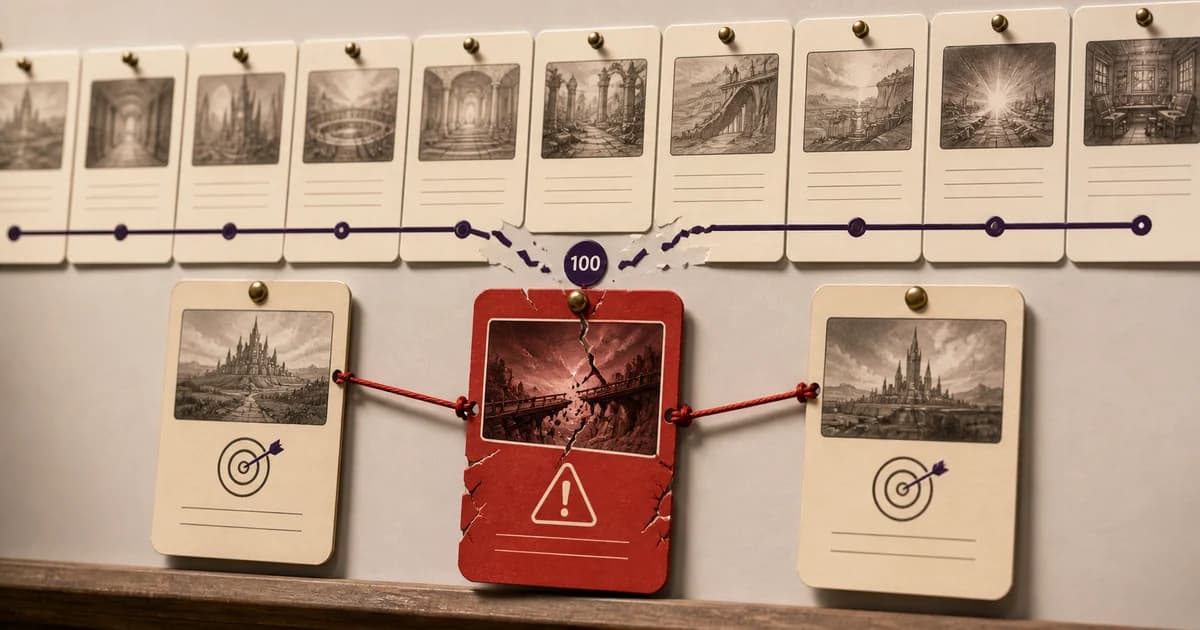
A web novel synopsis does not get long just because it has many events. If the protagonist's goal, conflict, relationships, or situation stay the same after an event happens, readers feel the story has stalled. The same problem occurs when a scene reconfirms information the reader already has.
When compressing a synopsis, check the change produced in the plot before you consider how entertaining the scene is. If the next event still flows naturally after you delete one event, that event is a deletion candidate. If a needed change remains but a similar event repeats, merge them. If only the outcome of an event matters, trim the setup and explanation around it.
Standards for Finding Slow Stretches in a Web Novel Synopsis
A slow stretch is not the same thing as a quiet scene. A calm conversation still does its job if it flips a relationship or raises a new question. Conversely, even a run of fights and chases leaves the web novel plot stuck in place if the goal and situation never change.
Attach the following questions to each event in the synopsis.
- Does the protagonist's goal newly appear or become more specific?
- Does an existing conflict intensify, resolve, or shift direction?
- Do character relationships or the protagonist's situation change?
- Does new information or a new question arise for the reader?
- Does this event's outcome trigger the next event?
If every answer is vague, the stretch is likely dragging. Watch especially for events that just repeat an existing state, like "the protagonist resolves again," "a fact already known is explained to an ally," or "the enemy's threat is confirmed once more."
Comparing Before and After a Scene in One Sentence
Write the start and end of each scene like this to make any change visible.
- Start: The protagonist does not know who the traitor is.
- End: The protagonist suspects an ally is the traitor.
This scene contains both an information change and a relationship change. If the start and end are effectively the same, as below, it needs editing.
- Start: The protagonist does not trust an ally.
- End: The protagonist still does not trust the ally after their conversation.
Even if the dialogue is engaging, it is hard to justify at the synopsis stage. Revealing a new clue, escalating distrust into a break, or merging it into another event helps preserve pacing.
Comparing Outcomes, Not Wording, for Repeated Events
Even if the location and characters differ, an event can still be a repeat if the outcome is the same. If the protagonist is warned at the guild, hears about the same danger at a tavern, and gets it confirmed again by an ally, the plot function of all three scenes largely overlaps.
Write down a short outcome for each event card. If "learns the enemy is strong" shows up multiple times, you can combine it into one event that delivers the danger information, a relationship change, and the motivation for the next action all at once.
Function Standards for Keeping an Event in a Web Novel Plot
Writer's Digest's scene craft guidance recommends scenes that serve multiple functions among plot advancement, character development, theme, and suspense. The same standard applies to editing a synopsis. The more roles a single event carries, the more change it produces for the same length.
Scroll the table horizontally to see more.
| Event Function | Change to Verify in the Synopsis | Sign of a Weak Function |
|---|---|---|
| Plot advancement | A clue is gained, a choice is made, a failure occurs, or a next action follows | The goal and situation are the same before and after the event |
| Character development | Desire, judgment, relationships, or attitude change | A trait already shown is repeated through the same action |
| Conflict progression | An obstacle intensifies, resolves, or shifts direction | The same standoff repeats in a similar way |
| Suspense building | A new threat or a new reader question arises | Characters re-explain a danger the reader already knows |
| Theme reinforcement | A choice and its outcome make the story's central question concrete | The theme is stated in dialogue with no effect on the events |
You do not need to treat this as a mechanical scorecard. Some events, like a true turning point, deserve to stay for plot advancement alone. What matters is whether you can clearly state the role an event plays in the overall story.
Checking Events That Can't State a Purpose or Reader Reaction
Write three sentences for each event card.
- What is the purpose of this event?
- What does the reader feel after the event ends?
- What does the reader wonder next?
If all three sentences come out similar, or you struggle to write an answer, the scene's function is weak. If the scene feels too good to cut, first check whether you can add another function, like blocking the goal, changing a relationship, or revealing a clue.
Keeping Turning Points Fixed Even During Compression
A turning point is a moment that changes the direction of a character's actions or the flow of events. Scenes where an identity is revealed, an alliance breaks, or an existing goal is invalidated, changing later choices, fall into this category.
Before shortening a synopsis, mark the major turning points first. Then check whether the events sitting between turning points are preparing for a change or carrying an outcome forward, which makes it easier to decide how much to cut. Keeping the turning points intact means the overall direction of the web novel plot stays stable even after the length is reduced.
How to Decide Between Deleting, Merging, and Trimming Unnecessary Scenes
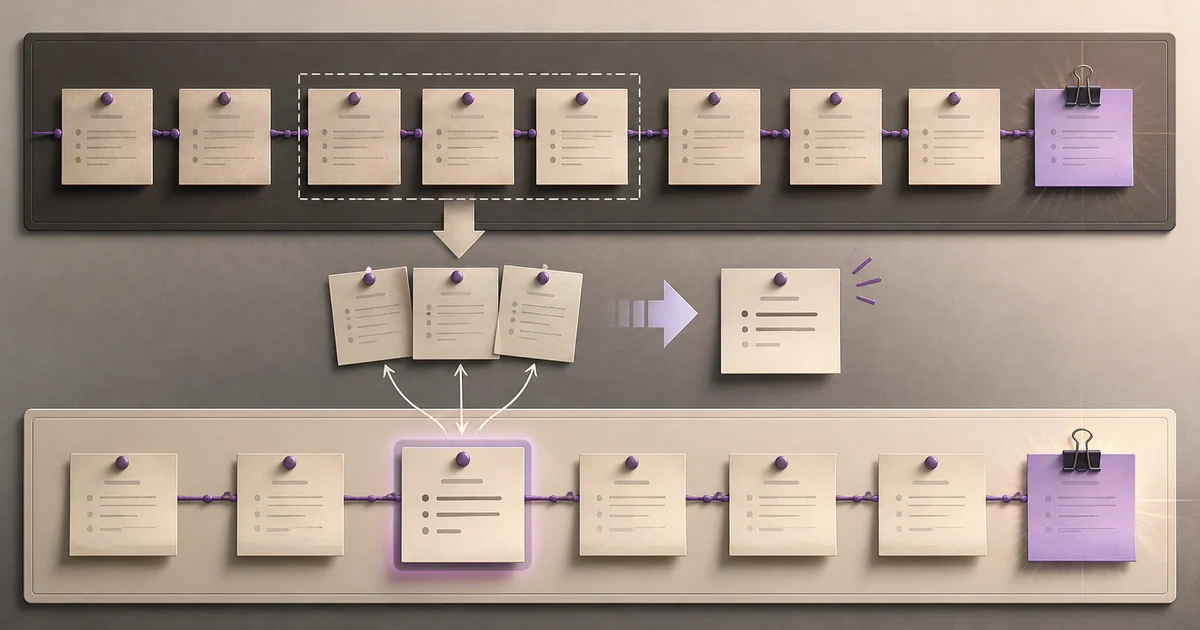
Deletion, merging, and trimming serve different purposes. Choose based on whether the scene has a function, whether it overlaps with another event, and how much information is actually needed.
Scroll the table horizontally to see more.
| Editing Method | Standard for Applying | Result |
|---|---|---|
| Delete | The goal, conflict, information, and causality hold up even without the scene | Remove the entire event card |
| Merge | Multiple events repeat the same function or information | Layer conflict, a relationship change, and a new question onto one event |
| Trim | The event's outcome is needed, but the setup and explanation run long | Delay the entry point and keep only the outcome and turning point |
Deleting a Scene: Does the Next Event Still Work Without It?
Cover the event card and connect the preceding and following events directly. If the protagonist's motivation and the information the reader needs are still understandable, you can delete it.
Common deletion candidates include:
- Dialogue that re-explains information the reader already has
- Internal monologue that reconfirms the same resolve or emotional state
- A meeting that does not change the intensity or direction of a conflict
- A one-off crisis that has no effect on the next event
- A scene that repeats an established character trait in the same way
If deleting a scene leaves only one small piece of information missing, you don't need to keep the whole scene. Just move the needed clue or line of dialogue into a neighboring event.
Merging Events: Layering the Same Function into One Scene
Merging means choosing one event out of several repeats and giving it multiple functions. For example, if the protagonist confirms the enemy's threat through two separate ambushes, you can combine them so that one ambush also reveals a clue about an ally's betrayal.
A merged event can flow like this.
- An enemy attack blocks the protagonist's goal.
- During the crisis, an ally makes a suspicious choice.
- The protagonist escapes the attack but starts to suspect the ally.
- That suspicion triggers the next investigation event.
A single event now creates goal obstruction, a relationship change, a new question, and the cause of the next action all at once. Repetition goes down and conflict density goes up.
Trimming a Scene: Keeping Only the Outcome and Turning Point
A scene needs trimming when it has a function but starts too early or explains too much. As in MasterClass's scene craft advice, starting at a point where the action is already underway makes it easy to drop the setup.
If a meeting scene runs long on reasons for attending, greetings, and background explanation, the synopsis can start from the moment the decision gets overturned. Likewise, for a battle, it is more useful to keep the cause of the defeat, the information gained, and the resulting goal change than the travel and preparation beforehand.
Parts you can usually trim include:
- Travel and preparation before an event begins
- Explanation that repeats background the reader already knows
- Multiple conversations that arrive at the same conclusion
- A reaction that continues with no change after a conflict ends
- Detailed actions that never carry over into the next event
How to Restore Conflict and Causality After Compressing a Synopsis
If the story suddenly jumps after you shorten scenes, the event you deleted was probably carrying a connecting link. Before restoring the entire event, try moving just the needed cause, information, or choice into the scene that remains.
Checking Whether a Prior Outcome Becomes the Reason for the Next Event
Read the remaining events by connecting them with "so."
"The protagonist found evidence of the betrayal. So they broke with their ally. So they had to enter the dungeon alone."
This is an arrangement where causality shows through. If only "and then" repeats, the events may just be sitting side by side without triggering each other. In that case, reorder the events or reinforce the choice and outcome that sets off the next action.
Keeping the Grounds for a Goal Change
Be especially careful with the moment a protagonist's goal changes. The event where the existing goal is achieved or invalidated, and the reason a more urgent goal appears, need to come first.
If a protagonist pursuing revenge suddenly sets out to save the kingdom, readers may feel the story has wandered off track. You need to keep the event where the revenge target turns out to be tied to the kingdom's crisis, or where the old goal becomes impossible to pursue, so the new goal follows naturally.
Re-Reading the Compressed Draft Around Its Turning Points
In the final review, look at the arrangement of events rather than the smoothness of the sentences.
- Does the inciting event actually move the protagonist to act?
- Does the goal or direction of action change at every major turning point?
- Does the conflict intensify, resolve, or shift direction instead of repeating?
- Does an event's outcome set up the start of the next scene?
- Does deleted information suddenly reappear later as a premise the story needs?
Rearranging the event cards while answering these questions helps you quickly find gaps left behind after compressing a synopsis. The Korea Creative Content Agency's web novel education program also treats protagonist goals, story connections, main and subplots, staircase structure, and revision as distinct steps. That is why cutting down the number of events and re-checking plot connections need to happen together.
Summary
- If a scene shows no change in goal, conflict, relationships, or situation before and after, it is a candidate for deletion or for adding a stronger function.
- Merge events that deliver the same information or produce the same outcome, and trim scenes where only the outcome matters by cutting the setup and repeated explanation.
- After compressing, keep the major turning points and the grounds for any goal change, and check that a prior event's outcome becomes the cause of the next one.
FAQ
How do I find slow stretches in a web novel synopsis?
Compare the goal, conflict, relationships, and situation before and after each event. If a scene only reconfirms existing information and feelings without producing real change, it is likely a slow stretch.
Which scenes are safe to delete?
You can delete a scene if the motivation for the next event and its causality still make sense without it, and the needed information remains. If only one piece of information is needed, just move that piece into another event instead.
What is the standard for merging synopsis events?
Merge events when different scenes repeat the same conflict information or the same outcome. Combining goal obstruction, a relationship change, and a new question into one event increases plot density.
Won't cutting repeated developments weaken the conflict?
Instead of showing similar clashes multiple times, make the outcome of one event change more. Don't stop at confirming danger, carry it forward into a broken relationship, a revised goal, or a new choice.
If the plot feels off after compressing, what should I check first?
Check whether the deleted event was carrying the cause of the next action or the grounds for a goal change. Move only the necessary connecting information into the remaining scene, then read the events together connected by "so" to spot the gap.
Was this article helpful?
Read next