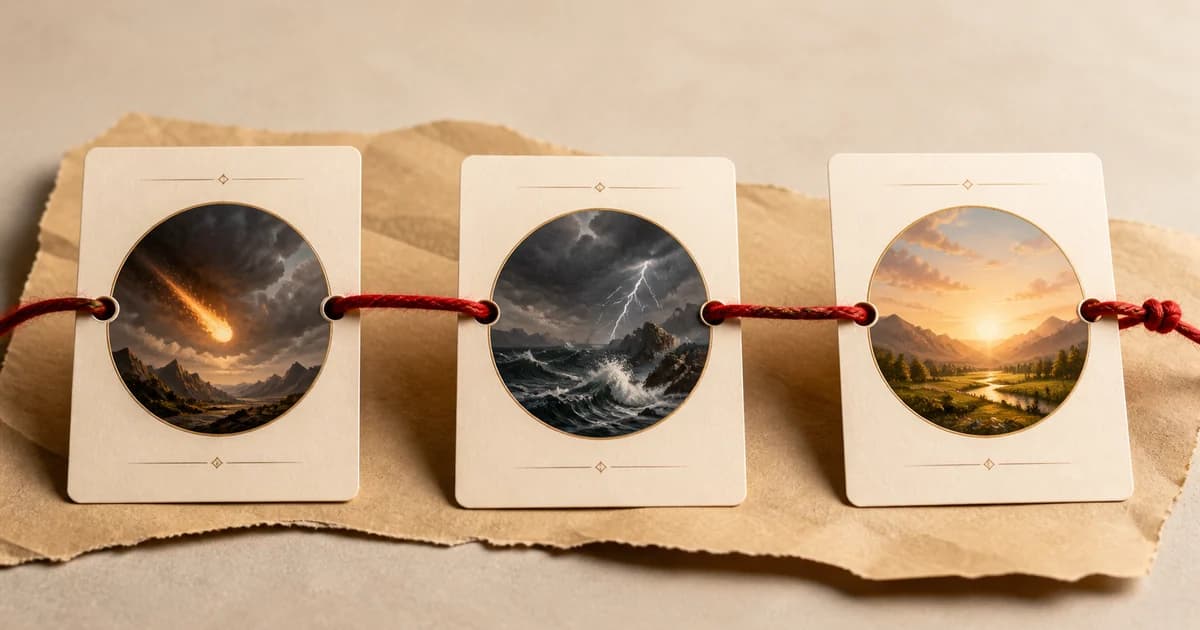
Sometimes a story wavers from the midpoint on, even with an interesting premise and a strong opening. Events keep happening but the direction grows unclear, and the planned ending drifts away from the conflict raised at the start. This is what's commonly called an anticlimactic plot.
This problem starts with the connections, not with how flashy the ending is. In the web novel synopsis, you should write down the inciting incident, the central conflict, and the ending's destination together, and check whether every major event in the middle links them.
The ending-connection formula can be summarized as follows.
The reader promise made early on → the protagonist's goal and central conflict → a middle section where difficulty and stakes rise → conflict resolution through a prepared choice → an ending that pays off the promise
A Web Novel Synopsis Is a Planning Document Covering Everything from Start to Finish
A web novel synopsis isn't promotional copy that introduces the early setup. It's an internal design document that condenses what event the story starts with, what the protagonist wants, what conflict they go through, and where they end up.
A finished synopsis should let you identify the following elements.
- The inciting incident that breaks the protagonist's routine
- The goal and central conflict that drive the entire story
- The major turning points that make achieving the goal harder
- The dramatic question the climax will answer
- How the conflict is resolved and the protagonist's final state
- The scope of foreshadowing and unresolved questions raised early that get paid off
Some writers leave the final scene out of their synopsis because they feel the ending should stay hidden. That's fine for a blurb shown to readers, but a planning synopsis needs the ending. It's hard to check a route while hiding the destination.
The Korea Creative Content Agency's hands-on web novel training also covers the full plot outline and the four-act plot structure as a planning task aimed at completing a series. In other words, planning shouldn't stop at a logline or an early idea, it needs to cover the whole structure through to completion.
The Connection Breakpoints That Turn a Web Novel Plot Anticlimactic
An anticlimax isn't a verdict caused by a short or quiet ending. It's felt strongly when the reader expectations built early on don't match the problem actually resolved at the end.
Scroll the table horizontally to see more.
| Breakpoint | Signs Visible in the Synopsis | Result in the Ending | Planning-Stage Check Question |
|---|---|---|---|
| Break between the inciting incident and the central conflict | The early event has no bearing on later developments | The opening remains just a device to grab attention | Without this event, would the protagonist's goal and ending also change? |
| Break between the central conflict and the middle developments | Many episodes occur but the goal's difficulty or stakes never rise | The middle feels repetitive or like a detour | Does this event make the ending's choice harder? |
| Break between the middle developments and the means of resolution | The ability, information, or character used at the end was never set up earlier | The resolution feels sudden | Does the cause or clue for the resolution appear in an earlier event? |
| Break between conflict resolution and the protagonist's change | The event ends but the protagonist's choice plays no part | The protagonist looks like a bystander at the ending | Whose decision produced the final outcome? |
| Break between the early promise and the ending | The story resolves a different problem than the one it first raised | The payoff readers expected feels missing | If you write chapter 1's promise as one sentence, does the ending answer it? |
The Early Premise Doesn't Lead into the Story's Central Conflict
Even with an eye-catching starting setup like regression, possession, a contract marriage, or a dungeon awakening, that setup doesn't automatically build a plot. The inciting incident needs to give the protagonist a goal, and that goal needs to grow into the central conflict that must be resolved by the end.
For example, if the protagonist regresses after being framed, what readers are waiting for isn't the regression itself but uncovering and confronting the structure that framed them. If the ending has them fighting an entirely different enemy while the frame-up gets wrapped up in a brief explanation, the original promise weakens.
Middle Events Don't Raise the Ending's Difficulty and Stakes
The middle isn't a stretch meant to pad out the episode count. Events placed in the rising action should make it harder for the protagonist to reach the goal and raise what's at stake if they fail.
If deleting a single event leaves the climax's choice, information, relationships, and stakes unchanged, that episode is likely weakly connected. Even an entertaining scene will gradually lose readers their sense of destination if it has nothing to do with the story's main line. It might seem like a web novel's length gives it room to spare, but the length is exactly what makes this more visible.
A New Resolution Device Suddenly Appears at the Ending
Dropping in a new character, a hidden ability, or an unrevealed rule at the last moment can end the conflict quickly. But if earlier choices and foreshadowing don't contribute to the outcome, the resolution loses credibility.
Whatever means gets used at the ending should be set up in the opening or the middle in at least one of the following forms.
- An ability the protagonist gained or trained
- An option that carries a cost if used wrong
- A world rule revealed in an earlier event
- Cooperation gained or lost through a change in relationships
- Information or foreshadowing that seemed minor at first
- A concrete cost the protagonist must accept to reach the goal
Foreshadowing isn't a device that reveals the answer ahead of time. It's about planting enough cause and possibility that readers, after seeing the ending, look back and think, that's why that scene was there.
The Web Novel Ending-Connection Formula: Working Backward from the Destination to the Inciting Incident
Connecting the ending doesn't have to be planned in chronological order. If you flesh out the planned ending first, then work backward to place the conditions that create that result, it becomes easier to spot gaps in the plot.
Step 1 - Write the Question the Ending Must Answer in One Sentence
The climax is the point where the central conflict peaks and the story's main dramatic question gets answered. So you need to nail down the question before describing the ending scene.
You can write examples in forms like these.
- Can the protagonist break away from the family that used them in order to take the throne?
- Can the protagonist prevent the tragedy from before their regression without losing themselves to revenge?
- Can two people who started with a contract choose each other beyond their mutual interests?
A good question contains the goal, the obstacle, and the direction of the choice together. If it's as broad as, will the protagonist be happy, it becomes hard to judge which events need to stay.
Step 2 - Split the Conflict's Resolution into Result and Cost
If you write a web novel's ending as simply, beats the villain, or the two of them end up together, that's not enough information to design the middle. You need to decide both what's gained and what's given up.
Try writing the ending's destination as the following four items.
- External result: What changes in reality, such as power, survival, victory, or a relationship?
- Internal change: What belief does the protagonist give up or accept?
- Decisive choice: Whose action, specifically, produced the result?
- Cost of resolution: What does the protagonist lose or become responsible for?
The more concrete these items are, the clearer the ability, relationships, foreshadowing, and cost you need to plant in the middle become.
Step 3 - Place the Ending's Means of Resolution in the Earlier Story
If the protagonist wins with an ally's help at the ending, the middle needs an event where trust is gained or lost. If they use a hidden rule, you need to show traces of that rule beforehand. If they choose to sacrifice something, you need to build up what they value enough for that choice to carry weight.
For each means of resolution, work backward through the following three questions.
- What gets used at the ending?
- When does the protagonist obtain or understand it?
- What choice and cost come with that process?
Without the third question, the means of resolution tends to stay a convenient tool. Connecting the acquisition of an ability or information to a character's choice makes the plot's progress and the protagonist's growth move in the same direction.
Step 4 - Make Each Turning Point in the Middle Harden the Ending's Choice
Major events in the middle need to add pressure to the central conflict. A structure that just gathers clues one by one moves the story forward but can flatten the tension. It's better to design things so that as information grows, choices get trickier, and even success creates a new cost.
Each turning point should create at least one of the following changes.
- The difficulty of reaching the goal increases.
- What's lost on failure grows bigger.
- Understanding of the enemy or obstacle changes.
- A trusted relationship shakes, or new cooperation forms.
- The protagonist realizes the old approach can't win.
- Both costs of the choice the ending demands become clear.
If none of these changes happen, that event can be condensed or merged with another.
Step 5 - Check That the Inciting Incident Is the Cause of the Final Choice
Now bring the plot you worked backward all the way to the beginning. The inciting incident is what set the protagonist in motion, and the ending needs to be the final response to the problem that incident raised.
You can check the whole story with a single connecting sentence.
Because of [the inciting incident], the protagonist takes on [a goal], goes through [the central conflict], and finally reaches [the ending's result] through [a decisive choice].
If a big logical leap shows up in the middle of the sentence, or the planned middle developments don't fit into it at all, that's a sign there's a gap between the synopsis and the ending.
How to Check Reader Expectations So the Early Promise Matches the Ending's Payoff
The reader promise is the experience a story leads readers to expect early on. The title, blurb, genre, inciting incident, and the protagonist's desire all combine to form this promise.
In a revenge story, the ending needs to address the target of revenge and its cost. In a coming of age story, it needs to address the limit the protagonist has to overcome. In a romance, it needs to address the conflict blocking the two characters' relationship. An open ending or a cliffhanger for a follow up season is possible too, but if the current story's central conflict is left completely unanswered, it can feel unfinished.
Pin Down the Reader Promise in Three Sentences
Completing the following sentences before you write the synopsis gives the story a baseline.
- After reading the opening, what do readers expect the protagonist to achieve?
- What's the biggest conflict blocking that goal?
- What choice and outcome does the ending need to show for readers to feel satisfied?
If different events and characters show up across the three answers, you need to revisit the central axis. If the opening promises revenge for the protagonist's family but the ending suddenly focuses on saving the kingdom, you need to either link the two conflicts causally or adjust how much weight one of them carries.
Separate Foreshadowing Payoff from Conflict Resolution
Paying off every piece of foreshadowing doesn't guarantee the central conflict is resolved. Conversely, defeating the villain doesn't guarantee the question the protagonist started with has been answered.
Foreshadowing payoff answers, what did the information or device presented earlier mean. Conflict resolution answers, what result did the protagonist produce between the goal and the obstacle. It's safer to mark these two kinds of answers separately in the synopsis's ending section.
A Practical Template for Checking a Web Novel Synopsis's Ending
The template below is built so you can check how well a web novel plot connects without rewriting the whole story.
Starting Point
- The protagonist's original state:
- The inciting incident that broke their routine:
- The concrete goal that arose after the incident:
- The outcome readers come to expect:
Central Conflict and Middle Developments
- The biggest obstacle blocking the goal:
- The approach the protagonist first chooses to solve it:
- The event where that approach fails or hits its limit:
- The turning point where the cost of failure grows:
- The ability, information, or relationship that sets up the ending's means of resolution:
- The belief or approach the protagonist must give up at the end:
Ending Destination
- The question the climax answers:
- The protagonist's decisive choice:
- The means of resolution set up in earlier developments:
- The external state that changes through the conflict's resolution:
- The protagonist's internal change:
- The early promise and foreshadowing that get paid off:
- Any unresolved question left deliberately open:
If you fill in each item with a sentence or two and still can't see the connection, adjust cause and effect before adding more length. The problem may not be that the synopsis is too short.
Final Questions to Screen Out an Anticlimactic Plot
Before you finalize your planning, try answering the questions below.
- If you remove the inciting incident, do the protagonist's goal and the ending both change too?
- Does each major middle event change at least one of difficulty, stakes, information, or relationships?
- Is the climax the peak of the central conflict that's run from the start?
- Is the ending's decisive means of resolution set up in earlier developments?
- Does the protagonist's choice produce the final result?
- Is the payoff promised early on confirmed at the ending?
- Among the major unresolved questions, have you distinguished which to close and which to leave open?
- Even if you choose an open ending, have you answered this narrative's central question?
If several of these are hard to answer, it's faster to redefine the central conflict than to start by fixing the ending scene. The ending is where the causes built up earlier all come together. Patching disconnected events with an explanation in the final few episodes can make the gap more noticeable, not less.
Summary
- A web novel synopsis needs to include the inciting incident, the central conflict, major turning points, the conflict's resolution, and the ending's destination together.
- Middle events in a web novel plot should raise the difficulty and stakes of the question the ending will answer, and set up the ability, information, and relationships needed for the resolution.
- To avoid an anticlimax, work backward from the ending's decisive choice and check that the means of resolution, the middle's turning points, and the early reader promise all connect through a single chain of cause and effect.
FAQ
Do I have to write the ending in a web novel synopsis?
Yes, it's better to write the ending in a planning synopsis. You need to know how the central conflict resolves and what state the protagonist ends up in to judge whether each middle event is necessary. This serves a different purpose than a blurb written for readers.
What's the most common reason a web novel plot becomes anticlimactic?
It's because the reader promise made early on doesn't match the conflict actually resolved at the ending. The same impression can arise when middle events don't raise the goal's difficulty or stakes, or when the ending's means of resolution wasn't set up beforehand.
How specific should a web novel's ending be at the planning stage?
You don't need to nail down the dialogue of the final scene. At minimum, it's good to fix the climax's question, the protagonist's decisive choice, the means of resolution, the cost paid, and the state after the conflict resolves.
What's a quick way to check whether the synopsis and the ending connect?
Try writing one sentence: because of the inciting incident, the protagonist takes on a goal, goes through the central conflict, and reaches the ending through a decisive choice. If the causal link in the middle is empty or a planned major event is missing, you need to strengthen the connection.
Does an open ending also need to pay off the early promise?
Even with an open ending, the current story's central question needs some kind of answer. You can leave conflict open for a follow up story, but if you defer the core conflict that's been building since the start, the sense of completion can weaken.
Was this article helpful?
Read next


