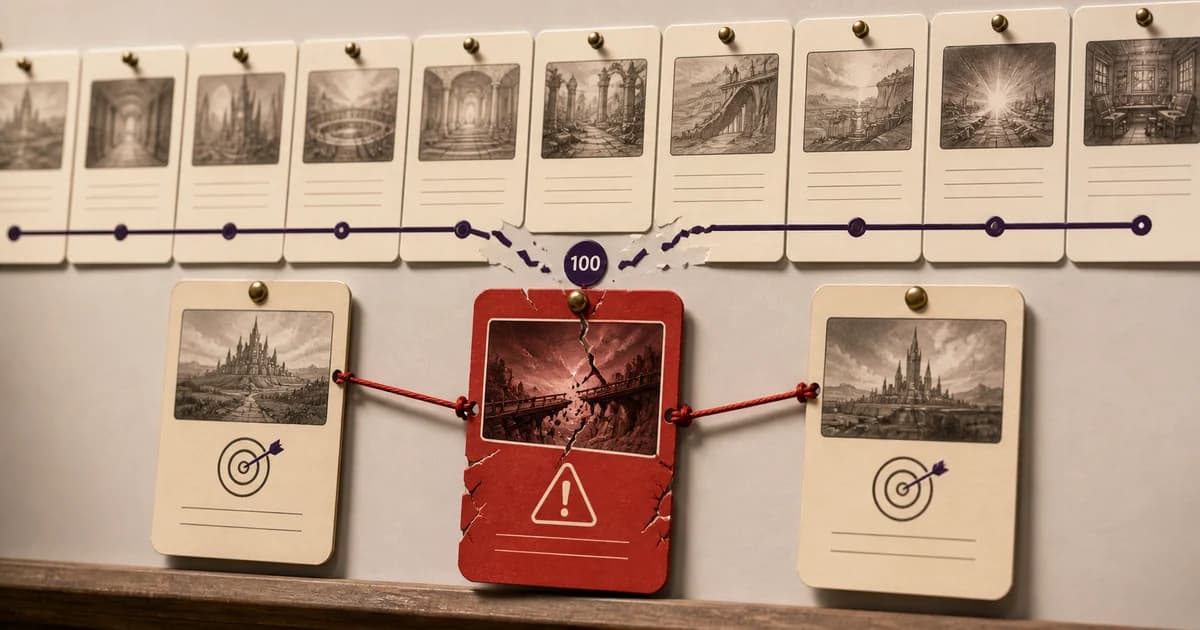
By the time serialization approaches episode 100, the protagonist has grown considerably stronger, defeated the early antagonists several times over, and the worldbuilding explanations are mostly done. But if the next episode brings another similar mission and reward, readers quickly notice the story is repeating itself.
The commonly cited "web novel episode 100 jinx" is not a rule stating that readers are bound to drop off at episode 100. There is no verified official statistic proving this, nor a fixed standard that applies to every work. It is more accurate to understand it as an editorial term for checking the stretch in long-running serialization where existing goals and conflicts tend to run dry.
At this stage, a web novel plot needs a change of direction as much as a strong event. A midpoint crisis is an event that shakes the success strategy the protagonist has relied on, causes an immediate loss, and forces the protagonist to choose a new goal to pursue in the second half.
The Plot Structure Behind the Web Novel Episode 100 Jinx
Midpoint stagnation doesn't happen only because events are lacking. Even if fights and conflicts continue, if their outcomes don't change the story's direction, readers see it as the same development repeating.
If the following pattern continues in your synopsis, it's time to check your midpoint design.
- The protagonist solves problems the same way from the start.
- Only the enemy's name and rank change, while the nature of the conflict stays the same.
- Winning doesn't change the existing goal or plan of action.
- Failure doesn't lead to a new choice or a long-term loss.
- New episodes start as separate requests rather than as results of the previous event.
- The second-half goal stays as vague as "become stronger."
A web novel synopsis that records each paragraph as a state description creates a similar problem. Writing "the protagonist grows within the guild" doesn't tell you what ends that growth or opens the next conflict. The result needs to trigger the next event, as in "the protagonist takes on a core role in the guild, but in the process the guild falls into a trap set by a hostile force."
The gap in the midpoint doesn't suddenly appear while writing the manuscript. It starts earlier, when the synopsis's transition section has no decisive turning point for the story, or when there's no clear decision about how long to keep repeating the early goal.
Three Elements a Midpoint Crisis Must Change
An effective web novel midpoint crisis links the crisis's cause, the immediate loss, and the subsequent plan of action into a single chain of cause and effect. If any one of the three is missing, even a big event can leave second-half momentum weak.
Scroll the table horizontally to see more.
| Design Element | What to Write in the Synopsis | What Happens When It's Missing |
|---|---|---|
| Trigger cause | What event the previous choices and conflicts bring about | The crisis feels like a random event that dropped out of nowhere |
| Immediate loss | What the protagonist loses or has threatened | The perceived risk feels low compared to the scale of the event |
| Changed plan of action | What the protagonist realizes and what action they choose | The story reverts to the old pattern after the twist |
| Follow-up goal | What must be achieved after the crisis and what conflict remains | The direction for writing the second half becomes unclear again |
Find the Crisis's Cause in Choices Planted Early On
A turning point readers find convincing is connected to earlier events. Design causes that accumulate from the early part of the story, such as the protagonist's misjudgment, a hidden secret, an enemy made during the process of succeeding, or the price of an ability used too conveniently, so they produce a result at the midpoint.
Suddenly introducing a stronger enemy can raise the stakes. But if the protagonist's goal and judgment stay the same, the plot's direction doesn't actually change. Conversely, if an early victory brings on a bigger conflict, readers will reread the earlier events as the cause of the crisis.
The Immediate Loss Must Shake the Protagonist's Success Strategy
Judge the loss by its effect on subsequent actions rather than by the number of defeats. If the protagonist loses a fight but recovers by the next episode and uses the same strategy again, the midpoint crisis isn't doing its job.
At least one of the following should change after the crisis.
- The state of the people or organization the protagonist must protect
- The means, such as abilities, status, or resources, that made the earlier success possible
- The trust or interests between the protagonist and their allies
- The information the protagonist has believed about the enemy and the world
- The validity of the goal pursued since the beginning
It helps if what the protagonist loses connects directly to what they must do next. If they lose an organization, rebuilding it or uncovering the truth can become the follow-up goal. If they lose a comrade's trust, repairing the relationship or choosing to part ways can serve the same role.
The Turn Is Completed by the Protagonist's Active Choice
The midpoint doesn't end the moment the event happens. The story's direction changes when the protagonist takes in new information, revises their plan, and makes a harder choice than before.
If the protagonist spent the early part of the story dodging attacks and reacting to circumstances, after the midpoint crisis they can start tracking down the source of the conflict themselves. If they were only chasing external rewards, they can now choose something or someone to protect and take responsibility for. Without this change, readers have nothing new to anticipate in the second half.
How to Write a Midpoint Crisis into a Web Novel Synopsis
Writing the midpoint crisis as simply "a strong enemy appears, the protagonist is in danger" is hard to use once you start writing the manuscript. It should be written as a single chain of cause-and-effect sentences that shows the event's before-and-after and the follow-up action.
Organizing it in the following order makes it easier to spot missing elements.
- Write down the existing goal the protagonist pursues up to the midpoint.
- Summarize in one sentence the success strategy that has achieved that goal.
- Attach the trigger cause of the crisis, brought on by earlier choices.
- Decide on the specific loss that occurs right after the crisis.
- Write down the new fact the protagonist learns or the change in their judgment.
- Distinguish between the goal to abandon, the goal to keep, and the new goal to choose.
- Break the follow-up goal down into several short-term events.
Combined into synopsis sentences, this becomes a structure like the following.
The protagonist keeps repeating a certain strategy to achieve their existing goal, but a crisis occurs because of a cause created by an earlier choice. As a result, they lose an important means or relationship and realize the existing plan can't resolve the final conflict. The protagonist chooses a new goal and takes on the first short-term task.
The important part here is the last sentence. If the aftermath of the crisis doesn't lead to the next action and an escalation of conflict, the midpoint crisis becomes a standalone twist that ends after a single shock.
Which Episode Should the Midpoint Crisis Be Placed In
You don't need to fix the midpoint crisis exactly at episode 100. It's more appropriate to place it based on the work's total expected length and the central turn of its major arc. The midpoint usually sits near the halfway mark of the story, but depending on the structure it can shift to a point closer to two thirds of the way through.
If the expected length is 200 episodes, checking around episode 100 first makes sense. That said, there's no reason to abruptly cut a growth arc short just to hit the number 100. If the whole work is long or made up of several major arcs, you can also design the overall midpoint turn and the turning point within each arc separately.
Judge the placement with the following questions.
- Have readers understood the early major promises and the rules of the world?
- Have you shown the existing goal and strategy working sufficiently?
- Can readers grasp the scale of the loss when that strategy collapses?
- Is there enough remaining serialized length to develop the new goal after the crisis?
- Can you introduce information or a choice that leads into the ending's conflict?
A crisis placed too early makes it hard for readers to feel the value of what was lost. One placed too late lengthens the repetitive stretch and leaves too little room to develop the new goal. The episode number is only a reference point. Narrative preparation and the possibility of follow-up development are what actually decide the placement.
How to Build a Second-Half Goal After the Midpoint Crisis
The second-half goal should resolve the crisis's loss while approaching the work's final conflict. If you just rename the pre-crisis goal and repeat it, the effect of the turn won't last.
For example, if the early goal was a promotion within an organization, after the midpoint crisis it can expand into uncovering the cause of the organization's collapse, reclaiming an organization that fell to the enemy, or building a force to face the final enemy without that organization. The flow feels natural because the result of the existing goal generates the follow-up goal.
Write the Long-Term Goal and Short-Term Events Together
Web novels are a serialized format that must hold readers' interest episode by episode. If you set only a long-term goal like "uncover the kingdom's conspiracy," you can end up stuck on what to write in the very next episode.
Break the long-term goal down into short chains of event and resolution.
- Secure the first means needed to carry out the new goal.
- Settle the relationship with one of the allies scattered by the crisis.
- Confirm part of the information the enemy hid, while leaving a bigger question behind.
- Place the first confrontation where the old success strategy doesn't work.
- Connect the cost created by the protagonist's new choice to the next event.
Each short-term event should resolve while also creating the next conflict. This makes it easier to maintain both episode-level satisfaction and long-term momentum through the second half.
Unresolved Conflict Becomes a Signpost for the Second Half
If you resolve every question in the midpoint crisis, the second half can end up as nothing but cleanup. Reveal the cause of the crisis, but you don't need to explain everything behind it and its ultimate purpose all at once.
In the synopsis, also write down the unresolved conflict to leave after the crisis. Who the protagonist should trust, what price they pay for achieving the new goal, and how the information gained from the crisis connects to the final enemy become the questions of the second half.
Midpoint Development Checklist
After finishing a draft, check whether the before-and-after change is clear, rather than how big the event itself is.
- Does the midpoint crisis occur as a result of early events?
- Is there a loss or threat the protagonist feels immediately?
- Can the existing goal or success strategy no longer stay as it was?
- Does the protagonist make a new choice beyond passive reaction?
- Is the follow-up goal to carry out right after the choice written as a sentence?
- Is the follow-up goal broken down into several short-term event and resolution chains?
- Does the risk level and direction of the conflict actually change after the crisis?
- Does the new goal lead into the main conflict of the ending?
If it's hard to answer several of these, reconnect cause and effect before making the crisis scene more spectacular. What stays with readers about the midpoint isn't the scale of the explosion, but where the protagonist goes after it.
Summary
- The web novel episode 100 jinx isn't a fixed rule about readers dropping off. It's a midpoint design signal for checking whether the existing goal and conflict are just repeating.
- A midpoint crisis must connect the trigger cause, the immediate loss, the protagonist's active choice, and the changed plan of action into a single chain of cause and effect.
- Right after the crisis, write both the second half's long-term goal and short event and resolution chains together to secure episode-level momentum.
FAQ
Does the midpoint crisis in a web novel synopsis have to be placed at episode 100?
No. Decide based on the total expected length and the turning point of the major arc. Check near the halfway mark of the story first, but you can adjust it to a point closer to two thirds through depending on the structure.
Does introducing a stronger enemy count as a midpoint crisis?
Introducing a strong enemy alone can be insufficient. The event needs to break down the protagonist's existing strategy and produce a loss and a new choice to function as a plot turning point.
Does the protagonist's goal have to change completely in the midpoint crisis?
It doesn't have to be fully discarded. It's fine if the meaning, priority, or method of achieving the existing goal changes instead. What matters is not returning to the same plan after the crisis.
How detailed should the second-half goal be?
It's best to write down the long-term goal, the first task to carry out, the main short-term events, and the conflict to leave unresolved. At minimum, you should be able to decide right away what the protagonist does in the episode right after the crisis.
Can a manuscript whose midpoint has already dragged on be fixed through the synopsis?
Yes. Gather the outcomes of the repeating episodes to find what loss they could produce, then reposition the turning point so that loss changes the existing goal and strategy.
Was this article helpful?
Read next


