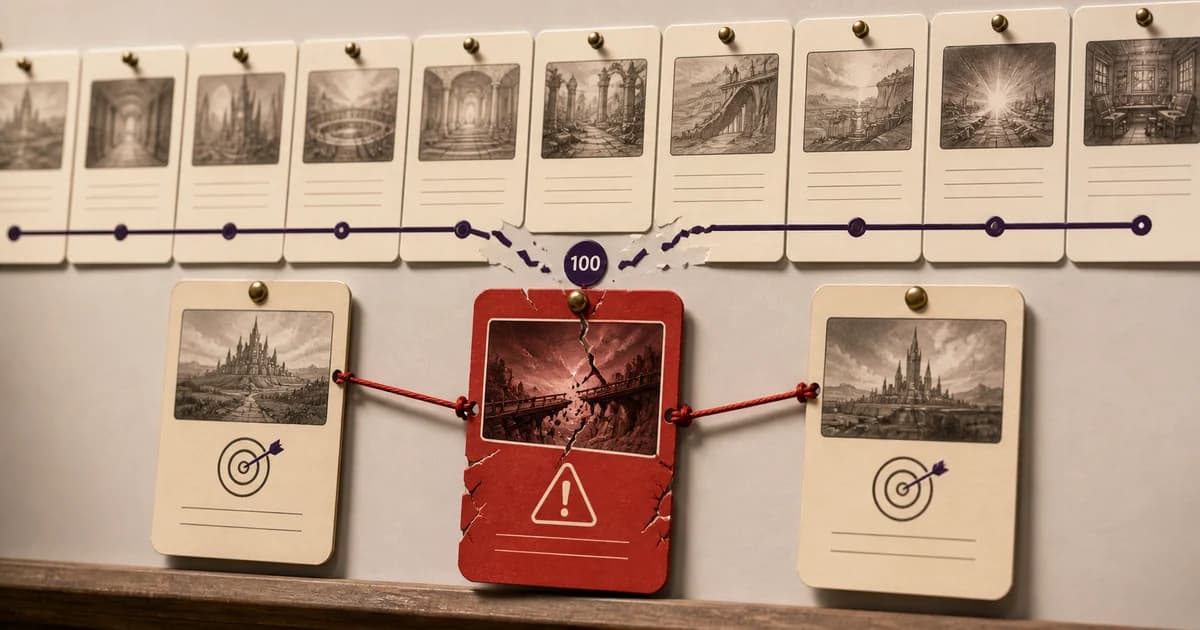
When a truth revealed in the later chapters completely transforms an ordinary early scene, that's when readers feel foreshadowing has truly paid off. Hiding an unexpected fact isn't enough on its own. The moment it's revealed, prior events and a character's actions need to connect causally so surprise turns into understanding.
A web novel synopsis is a planning document that lets you verify this connection before you start writing. If you decide the truth behind the ending first, then log the clues, misunderstandings, and reveal timing readers will encounter in the order events happen, you can cut down on both forced twists and long-winded exposition.
Why Foreshadowing Design Matters in a Web Novel Synopsis
Foreshadowing is a narrative device that hints at what's coming, building tension and curiosity while emotionally preparing readers for a big reveal. A twist that hasn't been set up might be momentarily surprising, but it tends to leave readers confused.
A well-executed foreshadowing payoff makes readers experience the following two reactions in sequence.
- Right after the reveal, they're surprised by a truth they didn't expect.
- Soon after, they recall earlier lines, actions, and objects and the story clicks into place.
- They reinterpret earlier scenes with new meaning.
So the quality of foreshadowing is better judged by how naturally it connects after the payoff, rather than by how well it was hidden.
Standards for Logging Foreshadowing and Plot Seeds in a Synopsis
On the ground, writers often broadly call information that builds curiosity a "plot seed." In a synopsis, you should write down the specific function of each piece of information to make it easier to manage.
For example, instead of stopping at "the protagonist's ring seems suspicious," log the following alongside it.
- The truth the ring will reveal in the later chapters
- The event and episode where it first appears
- The surface meaning readers will take from it at the time
- The scene where it resurfaces or gets reinforced in the middle chapters
- The trigger for the truth's reveal and its consequences
- The character choices that change after the payoff
Writing it this way lets you tell whether an early plot seed just creates mood and vanishes, or actually functions as a cause within the web novel's plot.
Designing a Web Novel Plot by Working Backward from the Payoff Point
Placing foreshadowing becomes clearer when you start from the ending. First decide the truth you'll reveal in the later chapters and the consequences it triggers, then work backward to place the information readers need in order to accept that truth.
Scroll the table horizontally to see more.
| Design Stage | What to Log in the Synopsis | Information the Reader Experiences | Question to Check |
|---|---|---|---|
| 1. Define the truth and consequences | The hidden fact, the trigger for its reveal, the character's choice and its cost | Not yet knowable | Does this truth actually change events? |
| 2. Present the early clue | First clue through dialogue, objects, actions, setting, etc | Perceived as ordinary or with a different meaning | Does it fit naturally within the scene's current purpose? |
| 3. Vary and reinforce in the middle | The clue reappears, misdirection, new information | Suspicion or misreading | Does the information advance instead of repeating the same explanation? |
| 4. Reveal the truth in the later chapters | The event where the clues converge on one meaning | Surprise and reinterpretation | Does it follow causally from prior events? |
| 5. Payoff after the reveal | Change in relationships, choices, resolution or escalation of conflict | Feeling the weight and cost of the reveal | Do real consequences follow the explanation? |
Step 1 - Decide the Truth to Pay Off and the Change It Brings to the Plot
The fact that "the ally was a traitor" alone doesn't complete your foreshadowing design. You also need to decide why they betrayed, what they were hiding, and what decision the protagonist makes after the reveal.
Try writing it in your synopsis as a single event, like this.
The ally has been watching the protagonist under orders from the royal court. Once their identity is exposed, instead of turning the protagonist over, they refuse the order, and both of them become targets of a manhunt.
This sentence contains the truth, the motive, and the consequences after the reveal. Now you can also see what clues you'll need early on. You can place the fact that the ally knows insider information about the court, a habit of watching the clock before reporting, and behavior of keeping tabs on the protagonist into earlier events.
Step 2 - Blend the Early Clue into the Purpose of the Current Scene
If you build a scene just to show off a clue, the reader's attention lingers there. It's more natural for the first appearance to happen within a scene that's already needed for conflict, a shift in relationships, or worldbuilding.
You can also spread the channels through which foreshadowing is expressed.
- Leave subtle knowledge or a verbal tic in dialogue.
- Hint at a hidden motive through a character's actions and habits.
- Use setting and atmosphere to set up danger to come.
- Put an image tied to a later event into a title or metaphor.
- Show an object's use first, then have it function in a later event.
Chekhov's gun can serve as a standard: information or an object presented with meaning should function in a later event. If you've introduced a notable object, check in your synopsis whether its purpose is decorative, worldbuilding, or a tool for a future event.
Step 3 - Vary or Reinforce the Clue's Meaning in the Middle Chapters
If you repeat the early clue as is, readers may guess the answer quickly or sense the author's emphasis. In the middle chapters, it's better to shine light on the same truth from a different angle.
Say you had the ally tense up at the sight of the royal crest early on. In the middle chapters, you could have them accidentally decode a royal cipher. Readers might guess "are they from the royal court?" but it's hard for them to pin down the truth that this person is a watcher. Once you add the ally's later attempt to destroy a report, suspicion grows and the plot moves forward.
Foreshadowing a single element three times is also a useful piece of practical advice. You don't need to treat it as a fixed number. If a long-form series has wide gaps between installments or the clue is small, expose it multiple times through presentation, variation, and reinforcement, while a short, strong clue can naturally use fewer exposures.
Separating Event, Character, and World Foreshadowing Strengthens a Twist
Foreshadowing doesn't only sit in plot events. A character's motives and the world's rules can also serve as clues that help readers understand what happens later. Checking these three types separately in your synopsis reduces your reliance on a single line of exposition to explain a twist.
Event Clues Set Up What Happened
This is information that becomes the cause or the means of resolution for a later event, like a missing record, an empty magazine, or a door that won't open. At the payoff, the connection between the early event and the later outcome needs to be visible.
Character Clues Set Up Why That Choice Was Made
Verbal tics, questions someone avoids, an oversensitive reaction to a particular subject, and the scope of someone's knowledge all fall here. In an identity twist, consistency of behavior can matter more as a clue than a name or appearance. Once the truth comes out, earlier choices need to read as motivated in a new way.
World Clues Set Up How That Event Was Possible
These are the rules that make an event possible, like the limits of magic, contract terms, or an organization's code of conduct. If you resolve a crisis at the ending with a rule that appears for the first time, readers may read it as convenient plotting. Show the rule early on, reveal an application or an exception in the middle, then connect that rule to a decisive outcome in the later chapters.
Designing Clues Readers Won't Notice but Will Still Accept
A good clue fits the scene on a first read and gains a different meaning after the payoff. Rather than erasing information, it's more reliable to create a situation that supports two readings.
Log the Surface Meaning and the Real Meaning Side by Side
Try logging "the reader's first interpretation" and "the interpretation after the payoff" side by side next to each clue in your synopsis.
For example, the ally stepping out every night at midnight might initially look like insomnia or a personal matter. After the truth comes out, it reads again as them going to report to the royal court. Both interpretations need to hold up within the scene at the time, or the misdirection will feel like a trick.
Adjust a Clue's Emphasis Through Amount of Information and Distance
How much a reader notices isn't determined by the number of clues alone. How much weight it carries in the scene, a character's reaction to it, the spacing between repetitions, and the urgency of other events all affect it together.
If a clue is too visible, before deleting it, try reinforcing the scene's central conflict or switching the channel of expression. Conversely, if it still doesn't connect after the payoff, you can make the early clue a bit more concrete or reinforce the varied information in the middle chapters.
Because the author already knows the ending, it's easy to feel that even a small hint is clear enough. What readers actually picked up on needs to be checked separately.
Conditions for Making a Foreshadowing Payoff Not Feel Like a Forced Twist
A natural twist aims for an ending that's "surprising yet inevitable." Even if readers didn't predict the truth, once it's revealed, they should be able to understand that the outcome was possible through the earlier clues and the sequence of events.
Evidence and Consequence Need to Move Together in the Reveal Scene
Having a character explain the backstory at length delivers information but can slow down the pace of events. Where possible, reveal the truth at the moment a hidden object is discovered, a world rule kicks in, or a character makes a decisive choice.
Right after the payoff, you need the following kinds of change.
- Relationships between characters break down or form anew.
- Prior goals get revised and new actions begin.
- The cause of an earlier event comes to light.
- A hidden cost or a bigger conflict becomes real.
If readers see the impact of the twist right after they understand it, the payoff in the later chapters lands more clearly.
You Don't Need to Re-Explain Every Clue
In the payoff scene, show the decisive connection that proves the truth. Listing off every line and object from earlier one by one reduces the pleasure readers get from piecing it together themselves.
If a brief callback or repeating the same phrase is enough to make the connection, you can trim the exposition. Structure the story so a character's later choices and the outcome of events carry the rest of the meaning.
Using a Foreshadowing Chart in Your Synopsis to Check for Unresolved Threads and Overexplaining
It's worth checking a foreshadowing chart twice, once before you write your draft and once after you finish the manuscript. At the planning stage, look at the spacing between placement and payoff. At the finished stage, check how much emphasis the clue actually got in the manuscript.
For each piece of foreshadowing, you can summarize the following in a single line.
- The truth and later event it connects to
- The episode and scene where the clue appears
- The channel of expression, such as dialogue, action, object, or setting
- The surface meaning readers will take from it at the time
- The scene where it's varied or reinforced in the middle
- The point and trigger of the payoff
- The change in the plot that follows the payoff
- Whether it needs to be cut or reinforced
Also check whether you have event clues, character motive clues, and world rule clues all supporting the same twist. If several clues are repeating the same fact, it's better to shift some of them to a different function.
Ask Beta Readers About Prediction and Understanding Separately
A single question like "did you enjoy the twist?" makes it hard to pinpoint problems with your clues. Splitting the following questions apart lets you check reader perception more specifically.
- What did you expect to happen right before the twist?
- When did you start suspecting the truth?
- What earlier scene came to mind first after the payoff?
- Was there any information that felt confusing or like it was newly added?
- Did the character's actions make sense after the truth was revealed?
If readers guess the truth too early, lower the emphasis. If nothing connects after the payoff, reinforce the clue. Also check where readers felt confused. It's possible they didn't understand not because of the twist itself, but because the world's rules or the character's motive weren't sufficiently set up.
Summary
- In a web novel synopsis, decide the truth and consequences you'll pay off in the later chapters first, then work backward through early presentation, mid-story variation and reinforcement, and the later reveal.
- Placing event clues, character motives, and world rules separately, and logging each clue's surface meaning alongside its real meaning, raises the sense that a twist was inevitable.
- After a foreshadowing payoff, earlier scenes need to be reinterpreted and a character's choices or conflicts need to actually change, so that the reader's surprise turns into a real narrative payoff.
FAQ
How do I mark foreshadowing in a web novel synopsis?
Next to each event, log the clue's content, its channel of expression, when it first appears, the reader's surface interpretation, the scene where it's reinforced in the middle, and the point and outcome of its payoff. Connecting a clue and its later event with the same identifying tag makes it easier to spot anything left unresolved.
At what point should foreshadowing be placed in a web novel plot?
Present it naturally early on, vary or reinforce it under a new context in the middle, and complete the causal connection at the truth's reveal in the later chapters. Adjust how often and how far apart you expose it based on the work's length and the clue's strength.
Does foreshadowing have to be shown exactly three times?
Three is a piece of practical advice you can use, not a fixed rule. In a long-form series where a small clue needs to stay memorable over time, you can vary it several times, while a short or strong clue can be enough with fewer exposures.
How do I fix it if readers guess the twist too quickly?
Rather than deleting the clue right away, check its emphasis and context first. You can tone down a character's reaction or place it within a different event, and spread repeated instances of the same expression across different channels like action, dialogue, and setting.
How much explanation is appropriate in a foreshadowing payoff scene?
It's best to clearly show only the decisive connection that proves the truth. Rather than listing every earlier clue, let a brief callback along with a character's choice and the outcome of events lead readers to piece together the rest of the meaning.
Was this article helpful?
Read next