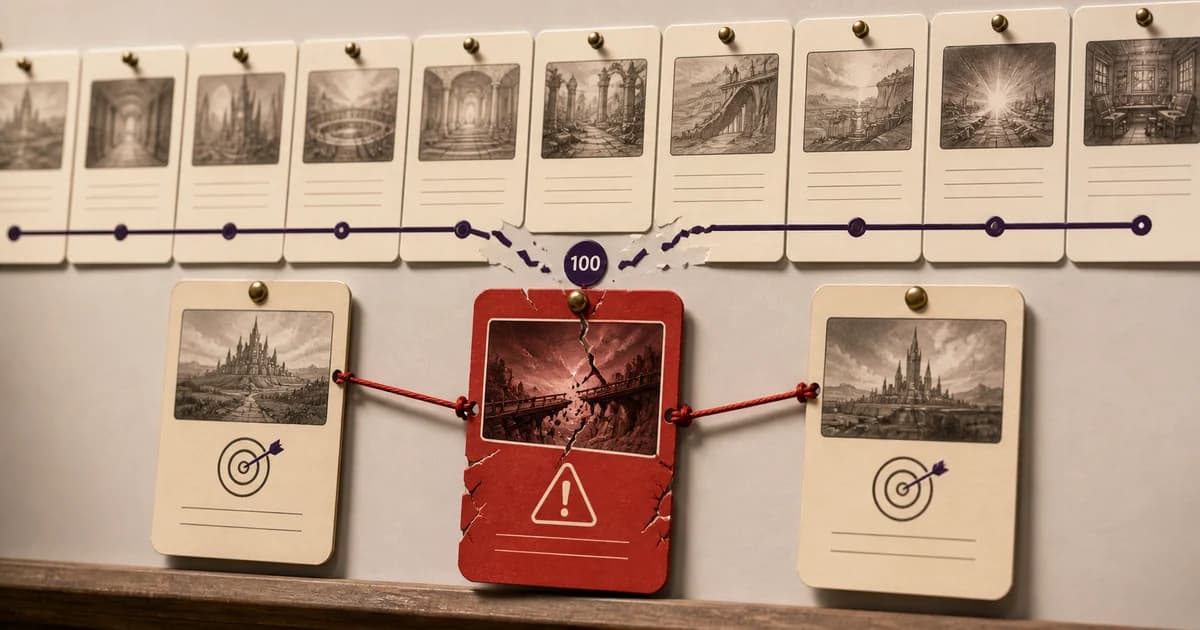
A web novel synopsis is a document that compresses the full narrative arc running from the opening to the ending, along with the major turning points. Writing only what events occur conveys the plot, but leaves unclear why this particular protagonist has to go through that event.
To add depth to the narrative, events need to be connected so they stir the protagonist's desire, expose their deficiency, and demand a choice. When that choice triggers the next event and ultimately leads to different behavior than at the start, the character arc is complete.
In short, the basic flow of a web novel plot looks like this.
- The protagonist acts to obtain what they want.
- The pressure of events reveals the limits of their familiar way of acting.
- As the cost of choices grows, internal conflict deepens too.
- A pivotal choice shows growth, corruption, or the establishment of conviction through action.
- The ending confirms what outcome the protagonist's original desire and deficiency ultimately met.
Why a Web Novel Synopsis Needs Character Change
In a synopsis, character change ties events together into a single chain of cause and effect. If all you have is Event A happening, then Event B happening, the story could roll on even without the protagonist. But if the next problem arises because of the protagonist's desire and choices, the story becomes uniquely theirs.
For example, the sentence "The protagonist, who enrolled in a magic academy, discovers a conspiracy" shows a situation. Connecting the character's motive to it changes the flow entirely.
"The protagonist, who wants to be recognized by their family, discovers the academy's conspiracy while trying to master forbidden magic. Revealing the truth could cost them their enrollment, but staying silent means a friend gets sacrificed."
The protagonist's desire drives them to touch forbidden magic, and the event creates conflict between their wish for recognition and their duty to protect a friend. Now the next scene raises curiosity not about the discovery itself, but about what the protagonist chooses to do.
The Protagonist's Starting State: Defining Desire, Deficiency, and Habitual Behavior
Character development isn't about piling on personality keywords. It's the process of deciding what the protagonist wants before the conflict begins, why they can't pursue it in a healthy way, and how they typically solve problems.
Desire Pulls the Protagonist Into the Events
Desire is the concrete external goal the protagonist is trying to achieve. Phrases like "wanting to succeed" or "wanting to be happy" make it hard to set a direction for action. Show what they're trying to obtain within the current plot.
- Reclaim the title of a fallen family.
- Find the traitor who killed them before their regression.
- Reach No. 1 in dungeon clear rankings.
- Build a foundation for independence before the contract marriage ends.
A good desire makes the protagonist plan instead of waiting around. The reason they dive into the first major event should come from here too.
Deficiency Shakes the Way They Pursue Their Desire
Deficiency doesn't just mean the protagonist lacks information or ability. It also includes the internal problem that makes them repeat flawed judgments while pursuing their goal.
A protagonist who desires recognition but can't trust others might try to claim all the credit alone. A protagonist whose goal is survival, but who sees accepting help as humiliating, might refuse an alliance even in a dangerous moment. Deficiency does its job only when it distorts choices, not when it just sits in a character profile.
The Current Behavior Pattern Is the Baseline for Measuring Change
Write down, in one sentence, the habit the protagonist uses to solve problems early in the conflict.
"Whenever they hit a crisis, they control the other party through a deal."
"They cut off relationships first, before they can be abandoned."
"They refuse to admit failure and take on an even riskier challenge instead."
This behavior pattern needs to work to some degree early on for it to feel convincing. Later, as the pressure of events grows, the same pattern causes bigger losses, and the protagonist has to choose whether to keep it or change it.
A Design Table for Connecting Desire and Deficiency in a Web Novel Plot
When writing a web novel synopsis, you don't need to explain every item below at length for every event. First check the cause and effect using a planning table, then compress only what's needed into the actual synopsis.
Scroll the table horizontally to see more.
| Design Element | What to Check | Result That Should Appear in the Synopsis |
|---|---|---|
| Desire | What is the protagonist trying to get right now | Their reason for taking part in the event |
| Deficiency | What internal problem distorts their judgment and actions | A choice that worsens the conflict |
| Event Pressure | What conditions make the old approach hard to use | A turning point that demands a choice |
| Stakes | What they lose or must bear if they fail | The weight of tension and choice |
| Pivotal Choice | What the protagonist gives up and what they choose | The action that reveals character change |
| Cost | What is lost through that choice | The sincerity of the choice and the conflict that follows |
| Result of Change | What changed among desire, deficiency, or relationships | The cause and effect that leads into the next event |
It's better to write the goal and the stakes separately. If the goal is "claim the throne," the stakes could be structured as "if they fail, their younger sibling is executed as a traitor." When what they want to gain and what they lose on failure are both visible, the external goal and internal conflict move together within the same event.
How to Turn Major Events Into the Protagonist's Choices
A bigger event doesn't automatically deepen the character arc. Even if the capital falls and the world faces annihilation, the protagonist can still look passive if all they do is move as instructed.
Check each major event against the following flow.
- The protagonist makes a plan to achieve their desire.
- They attempt direct action, producing a success or a failure.
- As a result, the deficiency and stakes become clearer.
- A harder choice than before becomes necessary.
- The result of that choice triggers the next event.
Write Motive and Response Together Into the Event Sentence
If you write "A rival guild steals the protagonist's dungeon," the subject of the event stays with the rival guild.
"The protagonist, determined to protect their reputation as the top clearer, enters an unverified dungeon before the rival guild can. Because they refused a request for backup, a teammate ends up isolated, and now they must choose between their clear record and that teammate's survival."
Written this way, the desire, deficiency, event pressure, and choice connect into a single flow. Not every sentence needs this much detail, but the protagonist's intent and response need to show at every major turning point.
Check What Changed After the Event
If the protagonist's goal, relationships, beliefs, and behavior pattern all stay exactly the same after passing through a major event, that event is likely missing from the character's story.
You should be able to answer at least one of the following questions.
- Did what the protagonist wanted or their goal change?
- What flawed choice did their deficiency lead them to make?
- How did their relationship with someone they trusted change?
- Did they succeed but end up paying a bigger price?
- How does a newly learned fact change their next plan?
Change doesn't necessarily mean growth. A deepening obsession or a reinforced false belief also counts as character change. What matters is whether the difference between the state before and after the event is reflected in the next action.
How to Shift a Character's Motive Naturally at a Turning Point
Many stories have a protagonist whose goal changes midway. A character bent on revenge might come to want to protect someone, or a character who only wanted success might decide to bring down the very organization they belong to. If the motive swaps suddenly, it gives the impression the author moved the character just to push the plot forward.
Shifting a motive can be built in three stages.
Establish Why the Old Desire No Longer Works
The protagonist approaches their goal using the method they've believed in all along. Even if they get some results, an unexpected cost has to follow. They might reach the position they wanted but lose a relationship that mattered, or the more their revenge succeeds, the more they come to resemble the person they hated.
Realization or Giving Up Needs Accumulated Evidence
If a lifelong belief changes because of a single piece of advice, the change feels flimsy. Repeated failure, shifting relationships, and the accumulated cost of choices should build up before the protagonist starts doubting their existing belief. In the synopsis, rather than listing every one of those scenes, just pick out the event and result that are decisive for the change.
The New Goal Has to Drive the Next Action
Don't end it with a statement that they've realized something. The new motive has to change their plans and actions. If a protagonist who was trying to survive alone decides to save a teammate instead, that has to be followed by giving up a safe escape route and heading back into a danger zone.
The Standard for Showing Character Growth Through a Pivotal Choice
A pivotal choice isn't a sentence explaining what the protagonist learned. It's the moment they act differently than before when faced with the same pressure. The choice needs something they give up and a cost they accept.
For example, if the protagonist sacrificed a teammate early on to protect their honor, you can make honor and that teammate's survival collide again at the climax. If they save the teammate this time even at the cost of their position, character growth is confirmed through action.
The choice differs depending on the direction of the character arc.
- In a growth arc, the choice goes beyond the existing deficiency.
- In a corruption arc, the character ultimately gives up a relationship or value for the sake of desire.
- In an arc that holds onto conviction, the character chooses their own values despite the pressure, and that choice drives change around them.
- In an arc where the goal is achieved but at a greater loss, both the achievement and the cost remain in the end.
Whichever direction it takes, if the same ending would be reached even without the protagonist choosing, the turning point loses its power. Check the cause and effect to make sure the final result comes from the protagonist's decision.
How to Complete Character Change in the Ending
The ending is where events get wrapped up, and also the point where you revisit the original desire and deficiency. If you only note whether the protagonist achieved their goal, the external plot closes, but the result of the character arc may go unresolved.
Deciding the ending first and working backward also makes it easier to select major events. Decide what state the protagonist needs to reach at the end, then check whether the turning points that make that final choice possible are laid out sufficiently earlier in the story.
Compare the Start and the Ending With the Same Questions
Scroll the table horizontally to see more.
| Comparison Point | Starting State | Ending State |
|---|---|---|
| Desire | What are they trying to get | Did they get it, give it up, or redefine it |
| Deficiency | What belief distorts their choices | Did they overcome it, worsen it, or accept it |
| Behavior Pattern | How do they respond to pressure | What choice do they make under the same pressure |
| Relationships | Do they use or push others away | How has their way of forming relationships changed |
| Cost | What do they refuse to lose no matter what | What did they end up accepting |
A protagonist who once used anyone to gain power might give up power in the end to protect a teammate. Or they might choose power after all and lose even their only teammate. Both endings can work as a character arc. What determines the quality is whether the earlier events and choices sufficiently set up that result.
A Practical Process for Fixing an Event List Synopsis
If a web novel synopsis you've already written is just a sequence of events, you don't need to rewrite it from scratch. Add the character's motive and choices alongside the existing events and check how well they connect.
Step 1: Compress the Starting State Into One Sentence
Try the structure "The protagonist wants X, but because of deficiency Y, they always act in way Z."
Here's an example.
"The protagonist wants their family's recognition, but out of fear of being abandoned, they try to claim all the credit for themselves."
This sentence should explain both the reason they dive into the first event and the mistake they make early on.
Step 2: Separate the Goal and the Stakes for Each Major Event
Write down separately what they're trying to gain in each event and what they lose if they fail. If either one is missing, the protagonist's action may be weak, or the tension may fall short.
Step 3: Insert a Choice Sentence Between Events
Find the parts connected as "A happens, then B happens." Try inserting a sentence in between: "Because of X, the protagonist makes decision Y, and that leads to B." This is a good way to spot sections that rely on coincidence or outside orders.
Step 4: Record What Changed at Each Turning Point
At least one of desire, deficiency, relationships, information, or behavior pattern needs to change. The changed element has to be used in the plan or response for the next event.
Step 5: Present the Same Pressure Again in the Ending
Placing a situation similar to the choice that exposed the deficiency early on into the ending makes the change stand out. If the protagonist acts differently this time, it shows growth or a settled conviction, and if they repeat the same choice in an even more extreme way, it reveals corruption.
Final Checklist for a Web Novel Synopsis Character Arc
Read through your finished synopsis and check the items below.
- Does the reason for taking part in the first event come from the protagonist's desire?
- Does the deficiency affect actual judgment and choices, beyond just being a profile note?
- Does each major event include the protagonist's plan or attempt?
- Are the goal and the cost of failure kept separate?
- Does the outcome of an event change the next choice?
- Is there a process readers can follow when the motive shifts?
- Does the pivotal choice show what is given up and what cost is accepted?
- Is the ending shaped by the protagonist's choice?
- When comparing the starting state and the ending state, does a difference show up in desire, relationships, conviction, or behavior pattern?
If several items are hard to answer, it's better to adjust the role of existing events before adding more. Reworking events you already have so they pressure the protagonist and force a choice strengthens both the plot and the character arc together.
Summary
- A web novel synopsis needs to show the protagonist's desire, deficiency, choices, and the result of change, alongside the sequence of events.
- Design major events to start from the protagonist's plans and attempts, create the cost of a choice, and let that result lead into the next event.
- Showing what choice the protagonist makes when faced with pressure similar to the start reveals growth, corruption, or the establishment of conviction through action in the ending.
FAQ
How do I build character change into a web novel synopsis?
Define the desire, deficiency, and behavior pattern in the starting state, then connect pressure, choice, and cost to each major event. Presenting either a choice that differs from the start or one repeated in a more extreme way at the ending makes the change clear.
How do I design the protagonist's growth in a web novel plot?
Have the deficiency cause a flawed choice early on, and let that choice create a loss. When the protagonist, after living through the accumulated results, makes a decision different from their old pattern at the climax, growth shows up as action.
What's the standard for turning a flat protagonist into a three-dimensional one?
The protagonist's desire and deficiency need to stand in tension with each other, and that clash has to affect their actual choices. Multiple sides of the character show up when what they want, what they fear, and the cost of their choices are all visible together.
How should events be connected to the character's choices?
Structure it so an event pressures the protagonist, the protagonist responds according to their desire and deficiency, and the result of that response triggers the next event. Just check the chain of cause and effect: event occurs, protagonist's choice, cost of the choice, next event.
Does character growth always have to be a positive change?
No. Growth that overcomes deficiency, corruption that gets consumed by desire, and change that holds onto conviction under pressure can all work as a character arc. Whichever direction it takes, the difference between the start and the ending needs to be confirmed through choices and results.
Was this article helpful?
Read next