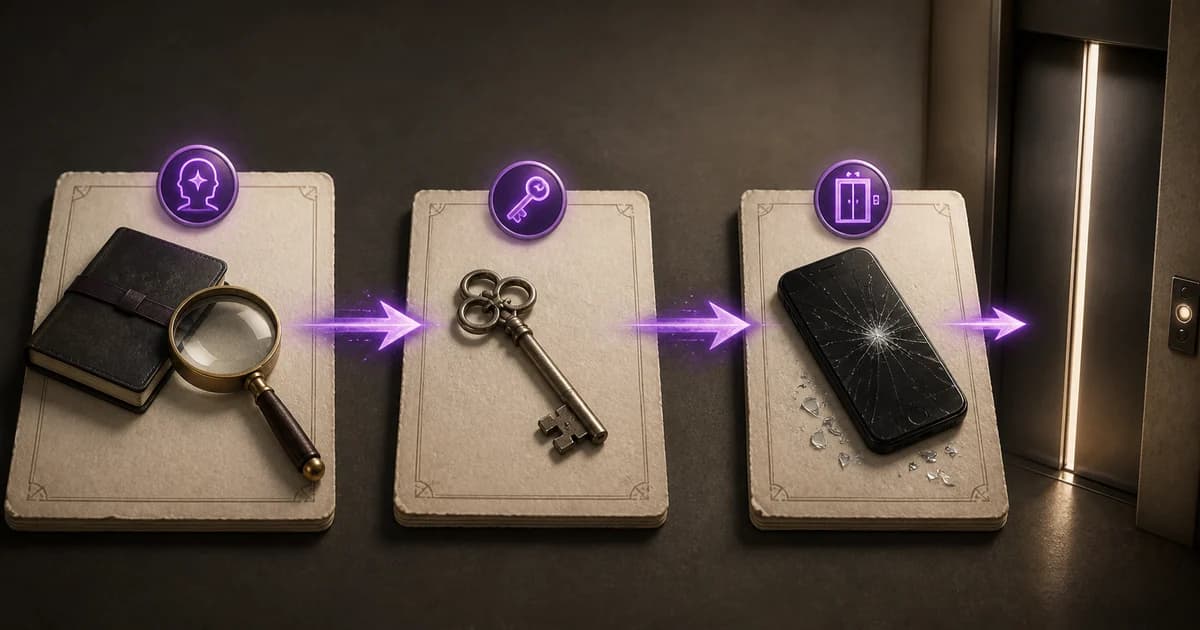
A protagonist who picked up a cracked phone hides the screen first. The elevator doors are closing, and someone is running down the hallway. Readers don't know the character's name or past yet, but one question stays with them. Why is this person hiding it so urgently?
Introducing the protagonist in a web novel's first chapter isn't a process of organizing and delivering character information. It's closer to a scene that lets readers watch the protagonist's actions, recognize the current problem, and then wait to see what choice comes next.
Here's a practical order for presenting information that works well in the field.
A specific present action, then the current problem and situation, then a short-term goal or choice, then as much backstory and worldbuilding as needed
This order pulls together a principle that several writing guides commonly stress, adapted for practical use. It isn't a formula that applies to every work or a number that guarantees results. The "three seconds" in the title isn't a measured statistic of reader response time either. It's best understood as a way of saying don't stall in the opening scene.
What a Web Novel's First Chapter Needs to Do When Introducing the Protagonist
A web novel's first chapter isn't a section for completing the protagonist's personal profile. If readers can answer at least three questions, the introduction has done its job.
- What is the protagonist doing right now
- What problem is driving that action
- What is the protagonist trying to achieve or choose in this scene
When these three connect, readers can follow the story even without every detail of the character's name, appearance, or upbringing. Conversely, even with rich worldbuilding, if the protagonist just stands still listening to exposition, readers have nowhere to rest their attention.
What matters more than the volume of information in a first chapter opening is the causal link between pieces of information. If a character holds a key, there needs to be a door to open. If that door is closed, there needs to be a reason to open it now. When that reason leads into the next action, the protagonist moves to the center of the narrative.
The Protagonist Introduction Order at a Glance
Scroll the table horizontally to see more.
| Presentation Order | Information to Show Readers | Question the Scene Raises | Watch Out For |
|---|---|---|---|
| 1. A specific action | What the protagonist is doing right now | Why is this happening? | Don't just list mundane actions at length |
| 2. The current problem and situation | The imbalance or conflict that triggered the action | What's going on here? | Don't explain the entire worldbuilding |
| 3. A short-term goal or choice | The outcome the protagonist wants to gain or avoid right now | What will they do now? | Don't explain the long-term goal all at once |
| 4. The minimum necessary backstory and setting | Information needed to understand the meaning of the current choice | Why make this choice? | Avoid backstory inserts that stop the scene |
Each step doesn't need its own separate explanation. In a well-constructed scene, a single action can reveal personality, circumstances, and surroundings all at once.
Step 1: Show the Protagonist's First Action First
A first appearance needs a motion readers can picture directly. An action like "he called an ambulance, then left the scene before it arrived" raises more questions than a description like "he was a cold person."
A good first action generally has these traits.
- It's immediately verifiable within the current scene.
- It carries a trace of the protagonist's judgment or habits.
- It connects to the surrounding situation.
- It produces a result that calls for the next action.
The action doesn't need to be flashy. An opening doesn't have to be a big event like a battle, a chase, or an accident. Folding up a termination notice and pocketing it, rejecting a call from an unknown number three times in a row, or dropping a last coin into a vending machine is enough. What matters is whether that motion touches on the protagonist's circumstances and perspective.
Personality Shows in How a Character Chooses to Act
Reactions differ even to the same crisis. When a door is locked, one person breaks it down, another talks their way through with a lie, and another waits for the key holder to return. This difference is personality itself.
If you want to show personality without explaining it, give the protagonist a choice, even a small one. What they choose, what they give up, and how they accept the cost of that choice becomes the character introduction.
Step 2: Attach the Current Problem and Situation Right After the Action
If there's action but no imbalance, readers watch the scene and then stop. After the first action, the current problem the protagonist must respond to needs to appear.
For example, if the protagonist repeatedly presses the elevator's close button, you can reveal whether the person running up behind them is a creditor, a security guard, or family they've long avoided. The information needed here just has to be enough to understand "why they're trying to close the door right now."
The current problem doesn't have to rely only on a villain's appearance. Obstacles and conflict can take many forms.
- A character who is tracking or hindering the protagonist
- An organization or institution that limits choices
- A space or environment that's hard to escape
- Internal conflict like guilt, fear, or obsession
- A scarce or precarious condition, such as money, time, or status
Include Only as Much Situational Explanation as Answers the Action
If you give the necessary clue right after readers ask "why is that happening," the explanation becomes part of the scene. If you unpack the world's history before the question even arises, it's hard to know what to remember.
The test is simple. If removing that explanation makes the current action incomprehensible, keep it. If removing it doesn't hurt the protagonist's choice or the scene's progress, it's a candidate to save for later.
Step 3: Confirm a Short-Term Goal or Choice Within the First Chapter
After showing the current problem, the story needs to move into what the protagonist intends to do. When the seed of a goal appears early, readers get a direction to follow into the next scene.
You don't need to fully explain a long-term goal like revenge, saving the world, or becoming the strongest, right from the first chapter. An immediately verifiable objective is enough.
- Trying to get into the elevator before it closes.
- Trying to stop debt collectors before the day is over.
- Trying to return a stolen key before getting caught.
- Trying to answer a call left by a missing sibling.
- Trying to confirm one fact with the person who fired them.
A short-term goal needs a condition that decides success or failure, such as running short on time, someone blocking the way, or having to make a risky choice to get what's wanted. Once an obstacle like this is attached, the goal shifts from exposition into an event.
If the Goal Is Hard to State, Show the Next Choice
If the story is one where the protagonist doesn't yet realize what they want, a choice can stand in for a goal. This means showing whether they run or turn back, hide a secret or reveal it, or reject or accept an unfamiliar offer.
Readers grasp a choice right in front of them faster than a grand life plan. When that choice opens the next scene, it also gives the first chapter its momentum.
Step 4: Reveal Backstory and Worldbuilding Only as Much as the Current Choice Needs
The protagonist's past matters. So does the worldbuilding. That's exactly why it's tempting to cram it all into the first paragraph. Hold off for a moment. In the first scene, backstory and setting are there to supplement the meaning of the current action.
If the protagonist hides at the sight of the police, you don't need to explain a full criminal record. If a single clue, that they once trusted the police and lost someone as a result, makes the current reaction understandable, that's enough for now. The detailed events can be revealed later, piece by piece, at moments when they collide with the protagonist's choices.
Information Worth Keeping in the First Chapter
The following information is worth including if it connects directly to the current scene.
- The reason the protagonist has no choice but to take a specific action
- The rules needed to judge how dangerous the current problem is
- The relationship or past that helps readers understand the cost of a choice
- A decisive clue that only the protagonist knows, or doesn't know
Information to Save for Later
The following can be interesting, but presenting it at length before the first appearance can slow the scene down.
- A childhood chronology that doesn't affect the current action
- The full history of regions and factions that aren't appearing right now
- Every single rule of an ability or profession
- An itemized rundown of appearance, personality, and family relationships
- Secret worldbuilding that isn't connected to the first chapter's choice
Hiding information doesn't automatically create curiosity. Readers need to see the current action and problem first for undisclosed information to remain a question. Hiding something with no clues at all can create more confusion than curiosity.
How to Fix a Web Novel First Chapter When the Protagonist Introduction Drags
If, in your draft, the protagonist spends a long stretch reminiscing about the past before moving, try changing the order before deleting the paragraph.
Move the Explanation Behind the Action
If the original sentence opens with "he had feared enclosed spaces since childhood," show the action of trying to get out of the elevator first. Attaching a brief memory or physical reaction at the moment the door won't open lets the past take part in the present scene.
Connect Appearance to Reactions and Choices
Rather than introducing hair color, height, and clothing all at once, pick out the traits that affect the action. Hiding a bloodstained hand under a wet suit sleeve, or pulling a hat low over a noticeable scar, are examples. When physical description meshes with the situation, readers don't have to memorize the information separately.
Explain Setting at the Moment It's Used
Genre rules like magic, regression, or hunters are also easier to understand when shown as they actually operate. A scene where the protagonist uses or breaks a rule and deals with the consequences can convey both the worldbuilding and the character's judgment at once.
Practical Questions for Checking Your First Chapter Opening
When revising a draft, check where the reader's attention moves rather than counting the amount of information.
- Does the protagonist act directly within the first scene?
- Does that action reveal the protagonist's judgment or temperament?
- Is the current problem that triggered the action made clear?
- Is there a short-term goal or choice that lets readers anticipate the next action?
- Can readers sense that an obstacle or conflict has appeared or is close by?
- Does the backstory and worldbuilding explanation serve to help understand the current scene?
- Have you piled up setting details early on that the scene would still make sense without?
- After reading the first chapter, does the question "what will this person do now?" remain?
Trying to resolve every item in the first sentence only makes the writing heavier. It helps to divide the scope: attach the action and the problem in the first scene, then confirm a short-term goal or an important choice before the first chapter ends.
An Example of a Protagonist's First Appearance: Turning Explanatory Order into Scene Order
An exposition-heavy opening usually follows this flow.
The protagonist lost his parents as a child and carried heavy debt. He was cold, but soft when it came to family. In this world, a certain key could open the way into a forbidden zone.
There's plenty of information, but nothing is happening right now. Rearranging the same content into action order sets the scene in motion.
He deleted his brother's message from the cracked phone. Footsteps grew closer down the end of the hallway. The gold key in his hand could open the door to the forbidden zone, and if midnight passed today, his brother would be taken away in place of the debt. He pushed the key into the locked door.
In this example, the act of deleting the message hints at the relationship and judgment involved, and the current problem of a pursuer closing in is attached. It then presents just enough about the key's function and the time limit before advancing the scene with the choice to open the door.
Readers can follow the protagonist's circumstances and goal without the personality being directly defined or the world's history being unpacked. The remaining backstory can be revealed later, at the moment the choices get harder.
Summary
- A web novel's first chapter can present protagonist information in this order: a specific action, the current problem and situation, a short-term goal or choice, then as much backstory and worldbuilding as needed.
- Show personality through how a choice is made rather than through description, and attach an obstacle or conflict to raise a question about the next action.
- Reveal backstory and setting only as much as needed to understand the current scene, and save the rest for the moment it's actually used.
FAQ
What information should a web novel's first chapter introduce about the protagonist first?
Show the specific action the protagonist is taking right now first. Then present the current problem that triggered it, the immediate goal or choice, and whatever backstory or setting is needed to understand the meaning of that choice, and the flow will feel natural.
How do you show personality in the first appearance scene without explaining it?
Give the protagonist a choice and show which method they pick. In the same crisis, the person who breaks through, the person who deceives, and the person who waits each reveal a different temperament and perspective.
How much of the protagonist's past should go into a web novel's first chapter?
Include it only up to the range needed to understand the current action and choice. If removing the backstory doesn't change the scene's meaning, it's better saved for a moment later when it connects to a conflict.
In what order should the current problem and the goal be presented?
Show the problem the protagonist must respond to first, then follow with what they intend to do to change that state. If the goal isn't clear yet, you can present a choice that opens the next scene instead, such as whether to flee or face it.
Is the "three seconds" in the title a verified reader response time?
It's hard to treat it as a verified figure. No reliable empirical evidence was found confirming that a web novel first chapter's protagonist introduction grabs reader attention within exactly three seconds. Here, the phrase is used to mean don't put lengthy explanation first, show the protagonist's action quickly instead.
Was this article helpful?
Read next
Related reading
 2026.10.142026 Web Novel Reader Reward Strategy for the First 3 Episodes That Drives Paid Conversion
 2026.10.12A Show, Don't Tell Guide to Revealing Worldbuilding Without Boring Setup in Your 2026 Web Novel Opening
 2026.10.272026 Guide to Long-Term Foreshadowing Management for Serial Novels Without Missed Plot Seeds