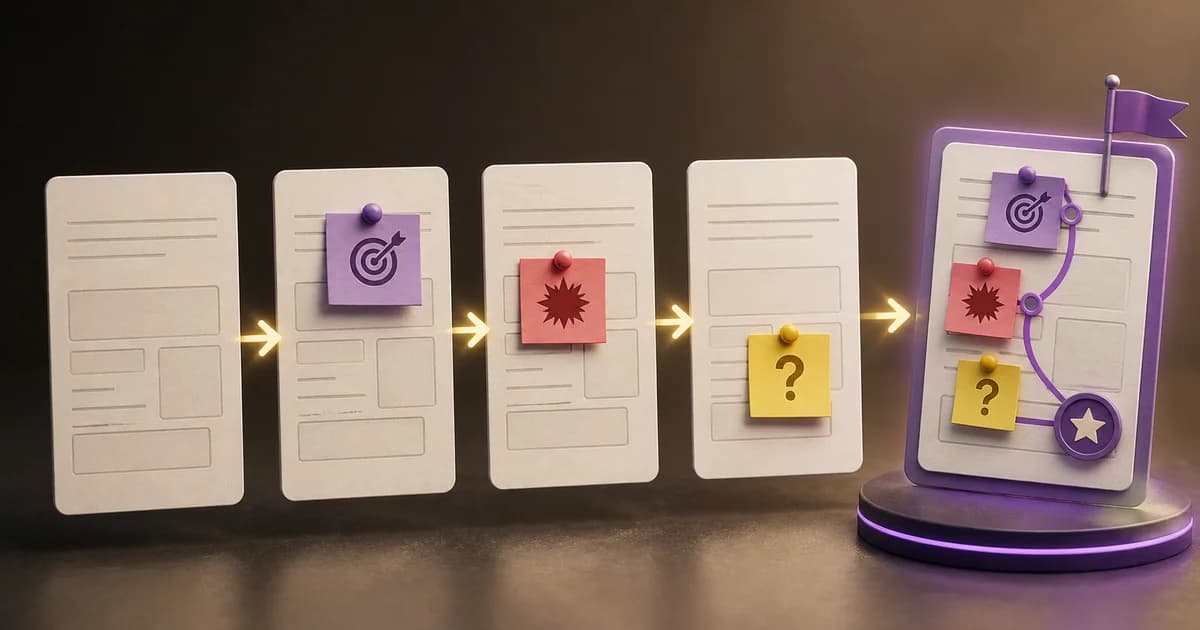
The manuscript reads smoothly, but you're not curious about the next scene. The characters talk and the necessary explanations are done, but no question remains when the episode closes. This is the "flat episode" that comes up often during web novel serialization.
You don't need to overhaul the whole manuscript in this case. First check whether each scene has a goal, an obstacle, and a change. Then tighten up explanation and repetition, and leave an unresolved choice or problem at the end of the episode. This can revive momentum while keeping the existing events intact.
Four Signs Your Web Novel Episode Is Falling Flat
A connecting episode isn't necessarily flat just because it's a connecting episode. Even without a major battle, the story moves forward if a relationship shifts or a new fact comes to light. Conversely, even if a lot seems to happen, readers can feel like they're stuck in place if there's no character choice and no consequence.
Check your current episode against the following criteria.
Scroll the table horizontally to see more.
| Checkpoint | State likely to feel flat | Change the episode needs |
|---|---|---|
| Plot progress | The situation before and after the scene is the same | A change of state occurs, such as a plan being carried out, failing, or a discovery |
| Character choice | The character simply accepts the given situation | The character decides on a direction while accepting a loss |
| Information reveal | Setting the reader already knows is explained again | A fact emerges that changes a judgment or a relationship |
| Unresolved issue | Dialogue and explanation wrap up neatly in every scene | A question or promise remains that the reader will wait for an answer to |
If all of the above are weak, there's a spot in the episode structure that needs work. If even one of them is clearly working, don't jump to cutting things. It may be faster to reposition that change so it's more visible.
Try Summarizing the Scene in One Sentence
Try summing up each scene as a sentence like "who wants what, but because of something, makes what choice."
For example, a summary like "the protagonist explains their past to a companion" doesn't show the goal or obstacle clearly. Rewriting it as "the protagonist reveals their past to gain a companion's cooperation, but only shares part of it because telling the most dangerous fact could cost their trust" shows the scene goal, the internal conflict, and the choice all at once.
If the sentence is hard to complete, one of the following is usually missing.
- What the character is trying to gain within the scene
- The external obstacle or internal conflict blocking that goal
- What is lost if the character fails
- The situation or relationship that changes once the scene ends
An Emergency Revision Order to Save a Flat Episode
Revising in the order of the opening, inside each scene, the middle stretch, and the end of the episode is efficient. The flow is to raise a question early, build pressure on the choice in the middle, and leave a problem that carries into the next episode at the end.
1. Pull the Opening Forward to Where the Action Starts
If a peaceful landscape description or situational explanation runs on too long, it's hard for readers to know what they should be waiting for in this episode. Try moving the moment when the character is already in motion or already in a tough spot up to become the opening scene.
You don't have to discard the existing description and background information. Just move as much of it as needed in between the action.
Before revision, the protagonist might describe the meeting venue and explain the attendees' relationships one by one. After revision, you could open with a hostile character shoving documents forward, and slip in a brief note about the seating and relationships while the protagonist checks the documents. It's the same event, written to present urgency and a question first.
2. Make the Scene Goal and Obstacle Clear in One Line Each
Conflict isn't limited to fighting or shouting. Conflict arises the moment an obstacle stands in front of a character trying to get something they want. It can come from outside, like another character's refusal, or start inside the character, like suspicion or guilt.
Try attaching the following three questions to your existing scene.
- What does the character want in this scene?
- Who or what is blocking it?
- What does the character lose right now if they fail?
For instance, in a conversation asking for permission, the tension ends the moment the other person agrees right away. Attaching a condition to that permission, or making the request's acceptance reveal a fact that had been hidden, gives the choice weight. This is possible without adding any major new event.
3. Leave a Small Consequence After the Choice
Even with a goal and an obstacle in place, momentum weakens if everything resets back to normal by the end of the scene. Let the consequence of the choice carry over into the next scene.
The consequence doesn't need to be dramatic. It's enough if an ally starts to suspect the protagonist, the time left to carry out a plan shrinks, or a piece of information the protagonist was trying to hide gets partly exposed. The key criterion is whether the state before and after the scene has changed.
Check whether one of the following changes remains after the scene ends.
- The plan advances or veers off in an unexpected direction.
- The trust and boundaries in a character relationship shift.
- New information shakes an existing judgment.
- The problem that needs solving, and the cost of failure, grows larger.
How to Tighten Explanation and Repetitive Scenes
Cutting everything just because there's a lot of explanation will leave readers unable to understand the situation. It's safer to adjust when the information is used and how it's delivered.
Summarize briefly whatever just needs to establish context quickly, and show emotional shifts or important choices through action, sensory detail, and dialogue. Placing necessary background information within the flow of the character dealing with the problem at hand can also cut down on stretches that feel like an information dump.
Attach Information Reveals to the Moment Conflict Occurs
If three paragraphs of setting explanation run before conflict even starts, try mixing up the order. The approach is to reveal only the information the character needs at the moment they have to make a decision.
For example, rather than giving a long history of a forbidden zone up front, revealing the rule that "whoever opens that door loses their right of succession" right as the protagonist is about to open it makes the choice and the information work at the same time. When an information reveal changes the outcome of a scene, readers also get a reason to remember the setting.
Keep Only the Sentences Where Repeated Emotion Leads to Change
If the protagonist already felt betrayed and the next scene repeats the same memory and emotion, the pace sags. In the second scene, cut back on repeating the emotion and instead show the action that changed because of that emotion.
Don't stop at "they still felt betrayed." Have them cut off contact, leak false information, or change the terms of cooperation instead. A scene moves forward when emotion leads to a choice.
Summarize or Merge Scenes With No New Change
A scene with no new event, no new information, and no change in relationships needs its purpose reconsidered. If it's a necessary transition or preparation step, handle it with a brief summary, and merge dialogue scenes that serve a similar role into one.
When you're unsure whether to cut a scene, ask "If this scene were missing, would the reader fail to understand the next choice?" If comprehension isn't affected and nothing changes, the scene is likely a candidate for tightening.
How to Give Readers a Reason to Read the Next Episode at the End
The end of an episode is where you promise readers what they'll find out in the next one. You don't need a life or death crisis every single time. Hesitation right before a decision, a newly revealed problem, or an unresolved cost can all work to pull readers into the next episode.
Cut Right Before a Decision
This works well when a character stands before options that each carry a different loss. Close the episode after creating a situation where readers are curious about which option gets chosen, more than the choice itself.
This method requires the options to be clearly distinct. If nothing changes no matter which option is chosen, the cut point alone won't be enough to create tension.
Reveal Unexpected Information and Leave Its Meaning Open
You can reveal a new fact at the very end of the episode, then have readers find out in the next episode how that information changes an existing relationship or plan.
Rather than relying only on a reveal like "the culprit was a companion," structure it so the questions keep going: why the companion did it, whether the protagonist will believe it, and whether the current plan can hold up. It's a form where an unexpected answer creates an even bigger need for confirmation.
Leave an Unresolved Cost
Even if a character achieves their goal, the episode keeps moving if a cost remains. This covers situations like escaping an enemy but having their identity exposed, or saving a companion but arriving late to a meeting place.
A cost left over after success is a good link to the next event without needing a forced twist. It needs to be a consequence that naturally arose from an earlier choice for it to feel convincing.
Criteria to Keep a Cliffhanger From Losing Reader Trust
A cliffhanger isn't limited to the technique of cutting off a crisis scene. You can also use an unexpected question, information that changes direction, or an answer that needs confirming.
A question left at the end of an episode is a promise you have to answer later. If the next episode just keeps explaining and keeps postponing the answer, fatigue can build up instead of tension. When you revise the ending, also decide how much you'll resolve in the next episode.
The criteria to check are simple.
- Can you state the question this episode leaves behind in one sentence?
- Is that question connected to the character's goal or the cost of failure?
- Does the beginning or a key scene of the next episode provide an answer, a clue, or a result?
- Is a new problem ready to follow once the answer is given?
A Final Check After Revising a Web Novel Episode
Once you've finished revising, check the flow of change rather than the number of flashy events. Momentum builds when an episode presents a goal, an obstacle forces a choice, and the consequence flows into the question left at the end of the episode.
As a last step, read through the manuscript and mark whether you can see the following sequence.
- The opening presents an immediate action or question.
- Each scene has something the character wants.
- An obstacle or internal conflict makes achieving the goal difficult.
- A change remains after the choice, in the event, the information, or the relationship.
- Repetitive explanation is tightened, and necessary information is placed at the moment of judgment.
- A question or cost that will be addressed in the next episode remains at the end of the episode.
Fix whichever of these six is missing first. Raising the tension in a web novel isn't about blindly adding more events. It's closer to editing that sharpens the goal and conflict already present in a scene and moves the change to a position where it's more visible.
Summary
- When a web novel episode feels flat, first check whether each scene has a goal, an obstacle, a choice, and a consequence.
- Tighten explanation and repetitive scenes, and place necessary information at the moment conflict and judgment occur.
- At the end of the episode, leave one of a decision, new information, or an unresolved cost, and follow through on that promise in the next episode.
FAQ
What should I fix first when a web novel episode feels flat?
Write down what the character wants in each scene in one sentence. If the goal isn't visible, the obstacle and the choice blur too. It's efficient to settle on the goal first, then attach what blocks it and what failure costs.
What's a natural way to add conflict to a flat episode?
Add a condition that makes achieving the existing goal harder. You can use external obstacles like another character's refusal, a lack of time, or a lack of information, as well as internal conflict such as suspicion, guilt, or clashing desires.
How should I trim down an episode that's heavy on explanation?
Summarize quick context briefly, and show emotional shifts and important choices through action or dialogue. If you move background information closer to the scene where the character actually needs to use it, the flow breaks less.
How should I end an episode so readers want to read the next one?
Choose whichever fits best with the change in the current episode, cutting right before a decision, revealing unexpected information, or leaving an unresolved cost. Whatever question you leave behind needs an answer, a clue, or a result in the next episode.
Was this article helpful?
Read next
Related reading
 2026.10.06The 2026 Fix for the No. 1 Cause of Reader Drop-off in Web Novel Serialization, Exposition Dumps
 2026.10.042026 Web Novel Serialization, First Person vs Third Person, How to Choose the Best POV for Your Story
 2026.10.032026 Episode Structure Basics: Cliffhanger Cut, Hooking, and Ending Connection Techniques