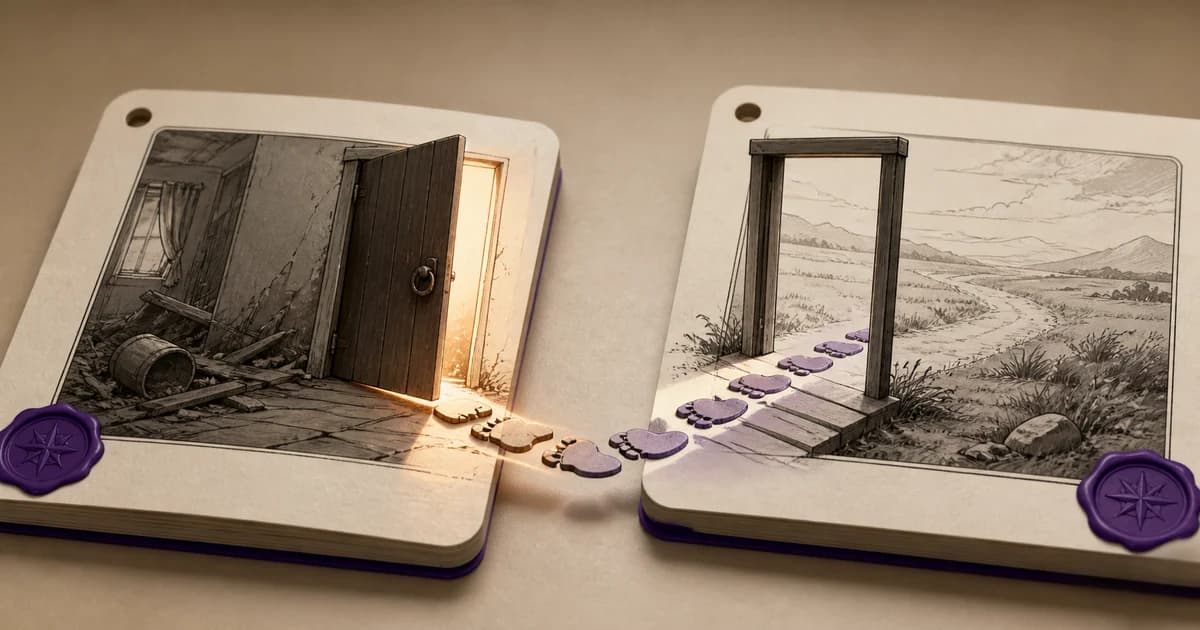
A web novel episode is a serialization unit that picks up the curiosity created in the previous episode, moves events forward, and hands off the changed situation to the next episode. Even if the opening line grabs attention, the middle grows loose if it doesn't connect to the episode's ending. Conversely, if only the final scene cuts sharply, it becomes hard to resolve at the start of the next episode.
A stable episode structure follows this flow.
- The episode's opening hook picks up the question the reader was left with at the previous ending.
- The protagonist's goal and actions change the situation.
- That change creates new unresolved information.
- The episode ends at the point where the reader needs to see the answer confirmed.
- The next episode's opening scene resolves or expands that question.
When this connection is in place, the cliffhanger cut doesn't feel forced. Readers open the next episode not because the writer cut the sentence, but because the events are still in motion.
Three Reasons Web Novel Episodes Fall Flat
Openings That Skip the Previous Episode's Question
Say the previous episode ended on "Who opened the door?" but the next episode opens with the protagonist's breakfast. No matter how polished the breakfast scene is, readers want to know who was outside the door first.
You can change the point of view or the setting, but even then you need a signal that the previous question still stands. Switch to the perspective of the person outside the door, or show a brief flashback to just before the door opened. Readers need to be able to see the relationship between the current scene and the answer they're waiting for.
Plots Where the Opening Hook and the Episode's Events Move Separately
If the opening scene reveals traces of an assassin, but from the midpoint the episode just follows guild registration procedures, the hook loses its force. The danger or question raised at the start of the episode has to affect the character's goal.
Established principles on scene structure also hold that a scene's job is to move the story forward, reveal character, and raise the stakes. A character with a goal has to act, meet obstacles, and as a result reach a state different from before, for the episode to read as a single unit of action.
Endings Placed Where the Next Episode Can't Pick Them Up
If the episode ends the moment the protagonist draws a sword, but the next episode skips the fight entirely, readers may feel the question was dodged. Suspense research also points out that the reading experience risks feeling frustrated when the text appears to ultimately ignore the question it raised.
If the episode ending leaves unresolved information, the next episode carries an implicit promise to follow up on it. Whether you answer immediately, reveal only part of it, or trade a delayed answer for more important information, readers need to be able to recognize the connection.
Episode Opening Hooks: What to Decide Before the First Sentence
Web novel hooking isn't just a technique for writing flashy lines. It's a structural device that gives readers a reason to keep reading right in the first sentence and first scene. One of these needs to kick in quickly: a question, a crisis, a shift in relationships, or unexpected information.
Choose the Question That Survived the Previous Ending
Before writing a new episode, try turning the previous episode's final scene into a question.
- What will the character whose identity was just revealed demand from the protagonist?
- Will the protagonist accept the forbidden offer?
- Will the weakness discovered right before the attack actually work?
- Is the trusted ally's betrayal real?
A good question changes the state of the core conflict depending on the answer. If the scope is as broad as "what happens now," the first scene's focus blurs too. 2026 narrative text research explains that questions about a key future event, along with the subordinate questions tied to it, correlate strongly with the suspense experience. If you want to connect the episode's ending to its opening, you first need to pin down exactly what the reader is trying to confirm.
The First Sentence Signals That Change Has Already Begun
The first sentence doesn't have to open with a scream, an explosion, or a death every time. It's strong enough if it simply makes clear that the character's usual state has been disrupted.
For example, if the previous episode ended with the discovery of a strange letter, the next episode could open like this.
The letter didn't have my name on it. It had my dead brother's.
This line partially resolves what's in the letter while creating a bigger question. Who sent it, why they used the dead brother's name, and what the protagonist will do all follow immediately. The first scene after this line can also move along the same question.
The First Scene Establishes the Character's Goal
If the scene just keeps explaining the situation at length, the hook never develops into an event. Show, within the first scene, what the character is trying to find out, stop, or obtain.
Don't stop at "read the letter." Push further, to "tears open the seal to find the sender." Once there's a goal, action follows, and action comes with obstacles and consequences. This is what creates the pacing inside the episode.
The Turn Inside an Episode: Carrying the Opening Hook Through to the Ending
The middle of an episode isn't filler between the opening and the ending. It's the section where the situation at the start is transformed into a different state by the ending.
In practice, it helps to write out these four steps, one line each.
- The current problem: What question or crisis carried over from the previous episode?
- The character's goal: What is the protagonist trying to do in this episode?
- Obstacles and shifts in information: What do they learn or lose while acting?
- The changed state: How have the options and risks changed by the end of this episode?
For example, let's build out an episode that opens with "the mysterious letter."
Scroll the table horizontally to see more.
| Episode Stage | What Happens in the Scene | The Question the Reader Follows |
|---|---|---|
| Episode opening | Confirms the letter bears the dead brother's name | How does the sender know about the brother's death? |
| Goal set | The protagonist traces the seal's origin | Can the location the letter came from be found? |
| Turn | Learns the seal is used only within the royal family | Was the royal family involved in the brother's death? |
| Episode ending | The crown prince produces a letter with the same seal | Is the crown prince an enemy or an ally? |
| Next episode opening | The crown prince reads the letter's first line aloud | How much does he actually know? |
The opening question shapes the investigation in the middle, and the results of that investigation lead to the confrontation at the ending. The final scene isn't an arbitrary shock scene tacked on, it's the result of the turn that occurred during this episode.
Web Novel Endings and the Cliffhanger Cut: Where to Make the Cut
The cliffhanger cut is a serialization technique that stops the text at a point of high tension. The resulting state of an unfinished event left behind is the cliffhanger. The two play different roles. The cliffhanger cut is the method of cutting, and the cliffhanger is the state left with the reader after the cut.
An effective episode ending needs these two conditions.
- Meaningful plot progress has to have happened in this episode.
- A concrete question that can be confirmed in the next episode has to remain.
A scene where the protagonist opens the door and sees an unexpected person can make a better ending than one where they just grip the doorknob. Readers are more curious about what the person who appeared will do than about whether the door opens. Withholding information at all costs isn't always the answer. Revealing part of it often produces a sharper question.
Cutting Right After a Reveal
Suited to moments when a new fact changes the meaning of an existing event.
The culprit's face was the same as his master's.
The next episode's question narrows from "who is the culprit" to "is the master the culprit, or is it something else wearing the same face." More information has been revealed, but the curiosity is more specific.
Cutting Right Before a Decision
Usable when a character's choice will significantly change a relationship or a goal.
The king held out the sword and the crown. "Choose one."
This kind of ending only works if the options are clear. The episode needs to show clearly enough, within itself, what cost comes with each choice. If you present the options with no context, readers feel a lack of explanation before they feel tension.
Cutting Right Before the Result of an Action Appears
Fits situations with an immediately verifiable result, like whether an attack succeeded, what's revealed behind an opened door, or what happens when a forbidden spell activates. Using this form often leaves the impression that the episode always stops mid-action, so mix it with reveal-type endings.
Cutting After a Crisis Shifts Into a New Stage
You could show that the protagonist has lost the fight, then end at the point where the enemy, instead of killing them, offers a deal. The earlier crisis is partly resolved, and a more complex conflict opens up. This is a good way to leave both the satisfaction that the episode moved forward and a question for the next episode.
Three Ways to Carry the Ending's Question Into the Next Episode's Opening Scene
The start of the next episode isn't the place to simply repeat the previous ending's tension. It's where you process the question left by the ending while creating new movement.
Scroll the table horizontally to see more.
| Connection Method | Role of the Next Episode's Opening Scene | When It Fits | Watch Out For |
|---|---|---|---|
| Immediate resolution | Shows the answer to the previous question right away | When the aftermath matters more than the result itself | A new goal or problem needs to appear right after the answer |
| Partial resolution | Reveals part of the truth and creates a narrower question | When the secret has multiple layers | Don't repeat the same answer with just different wording |
| Delay with a cost | Creates a risk or loss in the process of reaching the answer | When the character has to act to get the answer | Change the state so it doesn't look like stalling |
Immediate Resolution Raises the Pace
After an ending question like "is the crown prince an enemy," the crown prince could immediately propose an alliance. The question then shifts from "is he an ally" to "can that offer be trusted." This is a way to answer the earlier curiosity while opening up a more important conflict.
Partial Resolution Sharpens the Question
You could reveal that the crown prince isn't the sender of the letter, but that he was secretly in contact with the dead brother. This gives a small answer about identity while creating a new question about their relationship. Unresolved information decreases even as the story moves forward.
A Delay Needs a Cost Within the Plot
If an attack occurs the moment the crown prince is about to answer, that attack can't just be decoration to postpone the conversation. It needs to come with a real change, like the letter being stolen, the crown prince getting injured, or the protagonist's identity being exposed. The answer is delayed, but the delay only counts as an event if the situation has visibly gotten worse than before.
A Practical Sequence for Designing From the First Sentence to the Next Episode
If you write an episode in order and only look for a cut point at the end, the ending tends to be left to chance. Working backward briefly through the following steps lets you adjust the opening hook and the ending together.
- Write, in one sentence, the concrete question you want to leave at the end of this episode.
- Decide what information or turn is needed for that question to arise.
- Choose the goal the protagonist sets out to reach that turn.
- Build the opening scene that carries over from the previous episode's ending into the current goal.
- Note in advance how the next episode's opening scene will pick up the question.
- Choose the answer method from immediate resolution, partial resolution, or delay with a cost.
Deciding all the way through the last step helps you avoid cuts you can't follow through on. It also reduces the mistake of making only this episode's ending strong and then switching scenes in the next episode.
An Episode Structure Checklist for Web Novel Manuscripts
After finishing a draft, check the connection between the question and the event rather than how sensational the sentences are.
- Can the previous ending's question be recognized in the first scene?
- Does the episode's opening hook affect the protagonist's goal or actions?
- Does one of information, relationships, risk, or options change in the middle scenes?
- Can the episode ending's question be stated in one sentence?
- Does the state of the core conflict change depending on the answer?
- Was some small result or progress provided within this episode too?
- Does the next episode's opening scene pick up the previous question in a recognizable form?
- If the answer is delayed, does a new cost or change occur in the process?
- On a mobile screen, do the sentence rhythms of the opening and closing scenes avoid dragging on too long?
Naver Web Novel's official operating guidelines list readability suited to mobile reading as one of the selection criteria. There's no evidence that directly links view counts or algorithm effects to a specific ending type, but it's clear that an episode is a serialization unit released and managed independently. Beyond the connection between the opening and the ending, it's worth checking short paragraphs, dialogue placement, and the pace of information reveals against the actual mobile reading environment too.
Criteria for Avoiding Excessive Cliffhanger Cuts
If you cut right before the answer every single time, readers quickly notice the pattern. In particular, if the next episode repeatedly has the other character change the subject or has an outside event interrupt, readers start to doubt whether you actually intend to answer the question.
Endings like the following are worth reconsidering.
- Nothing changes in this episode, and only a new crisis is added.
- Information a character would confirm immediately goes unquestioned for no reason.
- The next episode repeats the previous scene at length.
- Bigger secrets keep getting piled on before the earlier question is ever answered.
- A character's judgment or actions become unnatural just to create a place to cut.
Suspense isn't determined by how much information you withhold. Readers need to be able to expect an answer, and that answer needs to connect to an important conflict in the story. If you leave a question hanging, show the direction of the resolution too. Only then does the cliffhanger cut function as serialization pacing rather than a delay that erodes trust.
Summary
- The episode's opening hook should take up the previous ending's question and convert it into the protagonist's current goal and actions.
- Place the episode ending at the point where the turn that occurred in this episode leaves a concrete, unresolved question.
- The next episode's opening scene should resolve that question immediately, resolve it partially, or delay it with a cost tied to the plot.
FAQ
Does a web novel episode's opening need to be strong from the first sentence?
The first sentence alone doesn't need to be sensational. It's enough if the first scene clearly presents a reason to keep reading, whether that's the previous episode's question, a current change, or the character's goal.
Is the cliffhanger cut a technique for cutting right before a crisis?
Right before a crisis is one possible spot, but it's not the only standard. You can also cut right after a reveal, right before an important decision, right before the result of an action, or after a crisis shifts into a different stage.
Does the curiosity from the episode ending need to be resolved right away in the next episode?
It doesn't have to be resolved immediately. You can reveal part of it or attach a cost to the process of getting the answer. It's best to avoid ignoring the previous question or delaying it with no change at all.
Does every episode need a cliffhanger?
Not every episode needs to end on a life or death crisis. Unresolved points that make readers want to see the next state, like a shift in a relationship, new information, or a difficult choice, are enough to work as cliffhangers.
When designing episode structure, should you start with the opening or the ending?
It's more stable to first decide the question you want to leave and how you'll handle it in the next episode, then work backward. Decide the necessary turn and the character's goal, and finally fit the opening scene that connects from the previous episode.
Was this article helpful?
Read next
Related reading
 2026.10.012026 Web Novel Serialization: The Golden Formula for Episode Structure That Prompts Next-Episode Purchases
 2026.09.242026 Web Novel Plotting: Building a 200-Episode Outline from a One-Page Synopsis
 2026.08.242026 Web Novel Writing: A Realistic Serialization Goal-Setting Method to Triple Your Completion Rate