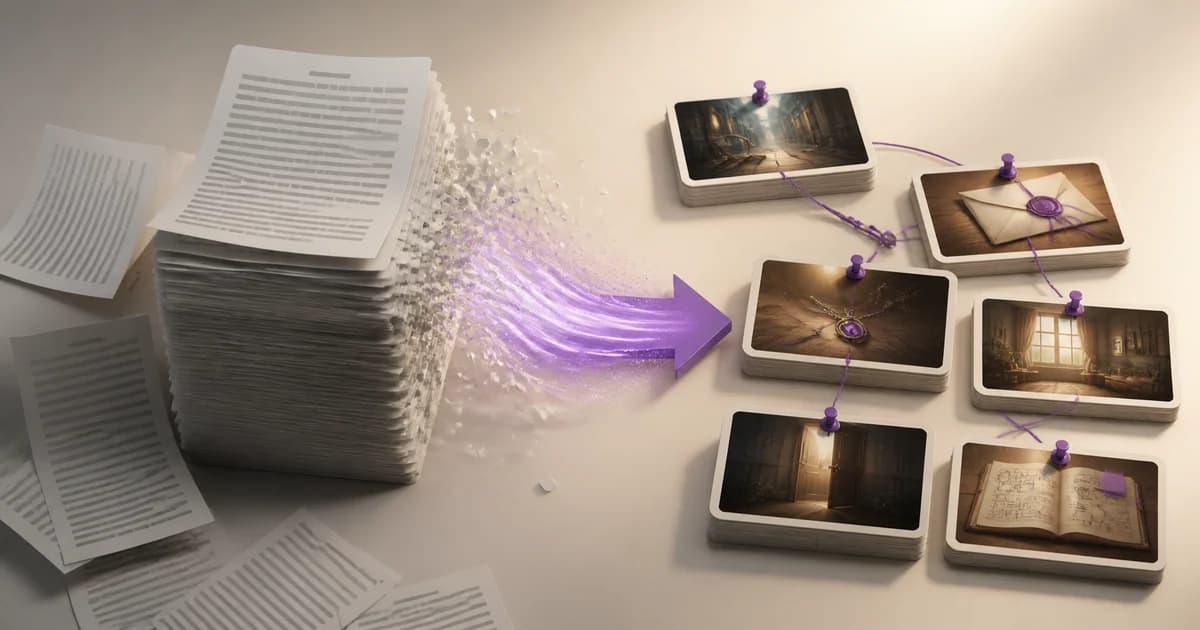
Readers scan the title, genre tags, and blurb on a work's detail page before deciding whether to open the first episode. The sentence that conveys a story's appeal fastest in this brief window is the web novel one-line pitch.
A one-line pitch is not a compressed summary of the entire story. It is closer to a pre-click promise that shows who the protagonist is, what unusual situation they are in, and what they must achieve or prevent. It cannot guarantee first episode views, but it clearly helps make the reader's reason to choose the story more distinct.
Why a Web Novel One-Line Pitch Matters for First Episode Clicks
Munpia's work detail page places a "View First Episode" button alongside the title, genre and tags, blurb, and work metrics. Novelpia also distinguishes between the blurb and the synopsis, and provides genre tags and a "View First Episode" button nearby.
In this structure, readers decide whether to enter before knowing the full narrative through to the ending. The short pitch sentence placed at the start of the blurb needs to quickly answer the following questions.
- What protagonist will the reader follow
- What unusual situation or relationship is at play
- What is at stake for the protagonist
- What kind of enjoyment can be expected in the first episode
Platform screen layout alone cannot prove a direct causal relationship between a one-line pitch and first episode views. Views can be affected by multiple factors together, including the title, cover, genre preference, and timing of serialization. Still, if the sentence read right before the click is vague, the story loses one chance to convey its core appeal.
How a One-Line Pitch Differs from a Synopsis
A common mistake when writing a one-line pitch is forcing a long synopsis into a single sentence. Adding the world setting, backstory, supporting characters, and twists increases the amount of information, but it blurs the reader's reason to click.
Scroll the table horizontally to see more.
| Category | One-Line Pitch | Synopsis |
|---|---|---|
| Main purpose | Conveys the story's central hook and reader expectations | Organizes the main events and narrative flow |
| Content to include | Protagonist, special situation, goal or risk | Setting, character relationships, conflict development, direction of the ending |
| Appropriate amount of information | Enough to make the first episode intriguing | Enough to review the entire story |
| Answer the reader gets | "Why should I open this story right now?" | "How does this story unfold?" |
| What to watch out for | Listing settings and abstract modifiers | Excessive detail that buries the central conflict |
The fact that Novelpia separates the blurb from the synopsis also supports the idea that these two documents serve different purposes. A one-line pitch should foreground the first payoff genre readers are waiting for and the central conflict, rather than the path to the ending.
Three Elements That Capture a Story's Core Appeal in One Sentence
There isn't much information to fit in one sentence. Choosing the protagonist, the abnormal core situation, and the goal or risk first makes the sentence solid.
Write the Protagonist So Their Desire Shows, Not Just Their Role
Broad phrasing like "There was a man" makes the character hard to remember. Choose a trait connected to the current conflict, such as occupation, a past failure, a lack, or a special ability.
For example, "a regressed stock market failure" packs in the character's past, ability, and the action readers can expect going forward. It's short, but the direction is clear.
The Core Situation Turns Genre Tags into a Scene
The Naver Webnovel mobile screen lets readers set their preferred genres and browse stories in the genres they want. Since readers may already arrive having seen the genre, the one-line pitch doesn't need to spend its sentence repeating the tag.
Rather than listing "Modern Fantasy, regression, finance story," show the situation in which those elements are at work.
A regressed stock market failure learns tomorrow's price ceiling stock, but this time he must stop a national default first.
The regression ability, the finance story material, personal desire, and a larger crisis connect as if in a single scene. Readers become curious why a character who can make money has to stop a national default.
The Goal and Risk Shape the First Episode's Direction
Writing only the protagonist and setting tends to stop at a character introduction. Try attaching one of the following to the end of the sentence.
- What must not be lost
- What event must be prevented
- What goal must be achieved right away
- What relationship or rule must be broken
Stating that a character "is caught in a forbidden relationship" establishes the situation, and connecting it to what they stand to lose because of that relationship gives the conflict weight. Readers respond more to the choice the protagonist is about to make than to the scale of the setting.
Steps for Writing a Web Novel Pitch Sentence That Draws Clicks
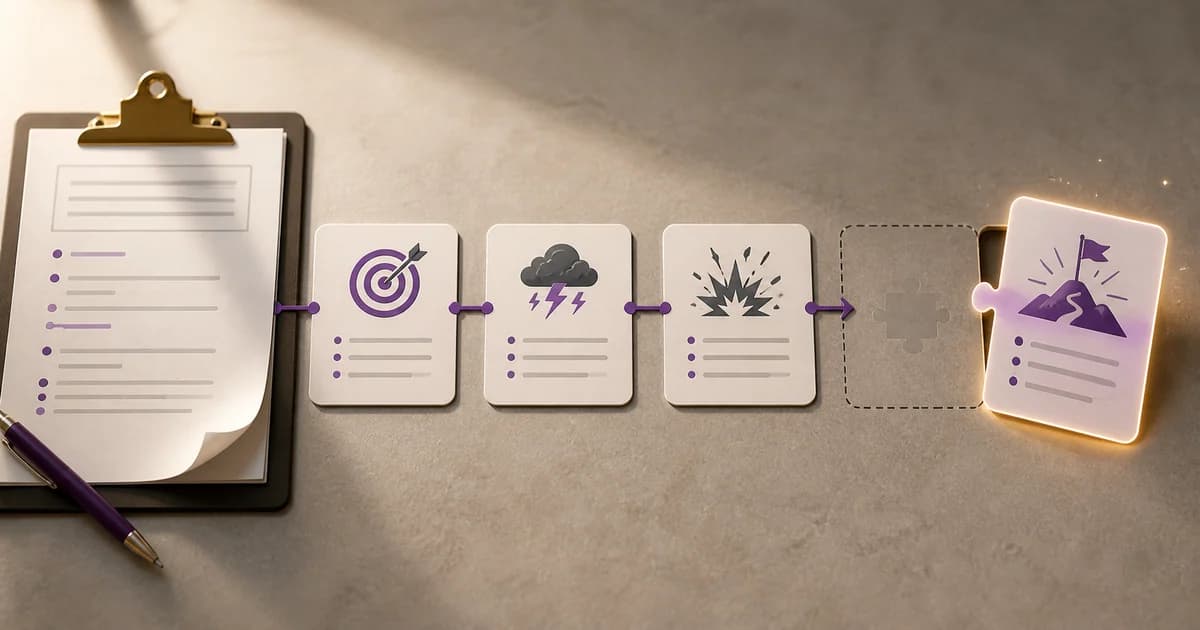
If you already have your material, there's no need to force a polished sentence from the start. Narrowing down the material in the order below quickly reveals the core of your one-line pitch.
1. Pick One Recurring Source of Enjoyment
Think of a scene readers will keep expecting throughout serialization. Enjoyment that repeats across many episodes works well, such as reversals using future knowledge, growth while hiding one's identity, or tension arising from a forbidden relationship.
At this stage, it's more useful to ask "What will readers keep waiting for in the next episode?" than to think about the size of the world setting.
2. Tie the Protagonist to the Current Conflict
Listing three or more traits for the protagonist quickly weighs the sentence down. Choose only one trait that directly affects the event happening right now.
- Weak phrasing: A protagonist with a special ability
- Specific phrasing: A mortician who can see the names of people about to die
- Weak phrasing: An office worker who returned to the past
- Specific phrasing: A new hire who returned to one day before being fired
Specificity doesn't come from the length of the explanation. You need information that would break the sentence if you swapped in a protagonist from a different story.
3. Attach the Goal or Loss as a Verb
Phrases like "confronts fate" or "faces a huge secret" fit almost any story. Writing what the protagonist prevents, seizes, hides, or reclaims as a concrete action also makes the first episode's direction clearer.
4. Strip Away Background Explanation
Check whether the sentence's appeal remains after removing the era, nation, magic system, and family history. Restore only the background that's essential to understanding the central hook. If the enjoyment disappears along with the setting, the story's core appeal is still hidden inside the setting explanation.
A Web Novel One-Line Pitch Formula and Revision Examples
The following structure is convenient for drafting.
[A specific protagonist] must [achieve a goal or prevent a risk] in [a special situation or relationship].
The formula is just a starting point. In the finished version, you can reorder or omit parts. What matters is that readers can recognize the protagonist, the central situation, and the story's promise.
A Sentence That Shows Only the Setting
Draft:
An exciting adventure unfolding in a vast world where magic and science coexist.
Revised:
An engineer who loses memories every time she uses magic restores her missing sister's final spell.
The revised sentence contains the protagonist's trait, the cost of her ability, and a concrete goal. The first episode could show the condition under which she loses memory or a clue about her sister's spell.
A Sentence Where the Protagonist's Distinctiveness Is Weak
Draft:
A story of an ordinary new hire succeeding at work.
Revised:
A new hire who returned to one day before being fired seizes the secret contract of the team that fired him, before they can.
The regression device leads directly into an action, and the direction of competition readers expect in a workplace story is also visible. What he does first is clearer than simply saying he "succeeds."
A Sentence with a Relationship but No Conflict
Draft:
A knight who falls in love with the heir of an enemy house.
Revised:
A knight sworn to protect the king hides the heir of an enemy house who has been named an assassin.
The relationship and the duty collide, creating a choice. Expectations for both romance and plot development can be built together within one sentence.
Connection Criteria That Raise the Odds of Converting to First Episode Views
It's best to show at least a hint of the enjoyment promised in the one-line pitch within the first episode. If you led with "a mortician who can see the names of people about to die," the first episode should reveal that ability, or an event should move forward as a result of seeing a name.
If the one-line pitch and the first episode aren't connected, a gap opens up between the story readers expected and the actual story. After finishing the pitch sentence, check the manuscript against the following criteria.
- Can the protagonist's key trait be confirmed in the first episode
- Does the special situation or central relationship begin
- Is what the protagonist stands to lose, or the goal they're pursuing, presented
- Is there a hint of the payoff or conflict genre readers would expect
- Does the question raised by reading the one-line pitch carry through to the end of the first episode
The official selection criteria for Naver Series Edition include the work's completeness, narrative creativity, mass appeal to communicate with diverse readers, and mobile readability. League promotion criteria also reflect cumulative figures such as views, favorites, and comments.
So it's more realistic to treat the one-line pitch not as a guarantee of performance, but as a tool for checking the story's promise of originality, mass appeal, and quick readability on mobile.
A One-Line Pitch Self-Check for Web Novel Authors
Read your finished sentence and answer the five questions below. This checklist is a practical set of criteria drawn from public blurb screens and official selection standards, and it is not the official writing guideline of any specific platform.
- Does the protagonist show through?
Even without a name, a trait connected to the current conflict should be visible, whether it's occupation, a lack, an ability, or a past failure.
- Does the core situation or relationship show through?
You need an event or relationship that pushes the protagonist into a choice they wouldn't normally make.
- Can you tell what's at stake?
If one of what will be lost, what must be prevented, or what goal will be achieved is revealed, readers can anticipate the narrative's direction.
- Could this sentence be attached to a different story as is?
If it still works after swapping only the protagonist and genre, you need to add more specific material or conflict.
- Does it show a hint of the promise in the first episode?
The ability, risk, relationship, or goal set up in the sentence must connect to the first episode for reader expectations to carry through.
There's no need to explain all five items at length. Weave them together as cause and effect within one sentence. If the structure is one where the protagonist's ability creates the risk, and that risk in turn creates the goal, the sentence reads naturally even when it carries a lot of information.
Summary
- A web novel one-line pitch is a sentence that connects the protagonist, a special situation, and a goal or risk to help readers decide whether to click.
- Rather than listing genre and setting, show the story's core appeal, what readers will expect from the serialization, through concrete action and conflict.
- There's no formula that guarantees first episode views, and placing a hint of the enjoyment promised in the pitch within the first episode is what lets the pitch and reader expectations connect naturally.
FAQ
How do you write a web novel one-line pitch?
Connect a specific protagonist, the special situation they're in, and what they must achieve or prevent into one sentence. Keep only as much background explanation as is needed to understand the central conflict.
What should a click-worthy web novel pitch include?
It should include what sets the protagonist apart, an unusual situation or relationship, and a goal or loss. A question readers want to see answered in the first episode should also arise naturally.
Does a one-line pitch increase first episode views?
There's no basis for guaranteeing a rise in views or asserting a direct causal relationship. A one-line pitch's role is to quickly convey the story's premise and the reason to read it on the pre-click screen.
Should genre and world setting also go into the one-line pitch?
Rather than writing out the genre name and every setting detail, show a situation that reveals the genre's appeal. Include world setting information only when it's essential to understanding the protagonist's choice or risk.
How do you check the appeal of a finished one-line pitch?
Check the protagonist, the core situation, the goal or risk, the story's own specificity, and the connection to the first episode, in that order. If the sentence could be attached to a different story as is, you need to make the material and action more specific.
Was this article helpful?
Read next