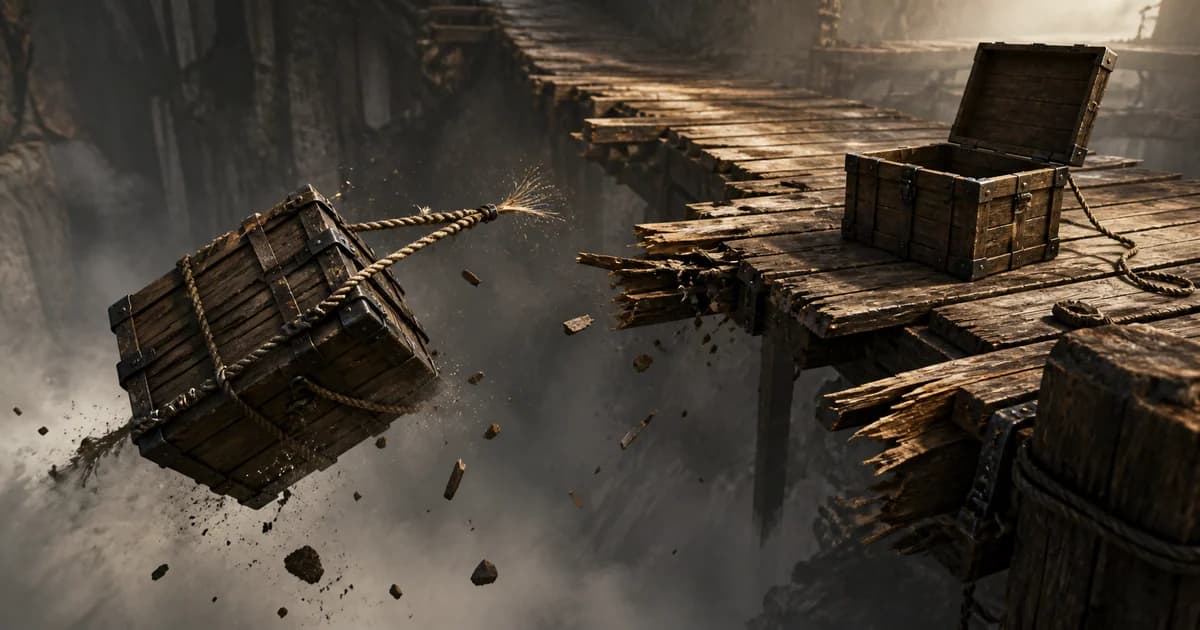
On a collapsing bridge, the protagonist cuts a rope to save a companion. The companion survives, but the supply crate tied to the rope falls into the ravine below. Only a day's worth of food remains until the next destination.
What makes this scene feel weighty isn't the sacrifice itself. It's that what the protagonist failed to protect is clear, and that loss limits their actions afterward.
In web novel serialization, a weighty protagonist choice is a decision made when a goal, a relationship, and safety cannot all be preserved at once, one where the protagonist actually bears the cost of what they give up. The cost of the choice needs to connect to action and cause and effect, and the outcome of the choice needs to keep functioning in later episodes.
Why Protagonist Choices Can Feel Weightless
A protagonist deciding quickly isn't a flaw by itself. A strong, capable character making fast calls can feel natural. Readers sense weightlessness when the state before and after the decision barely changes.
Say the protagonist saves a companion while both the companion and the supplies are in danger. If the hidden food is discovered right away, or a new ally suddenly provides supplies, the sacrifice disappears. The scene showed a decision, but the story lost nothing.
If the following signs keep showing up, it's worth checking the conditions of the choice itself.
- The protagonist suffers no real damage no matter which option they pick.
- The cost and risk aren't revealed before the choice, so the difficulty of the decision is hard to sense.
- The loss that follows the choice gets resolved within the same episode.
- A relationship change gets patched over with a line or two of dialogue and has no effect on later behavior.
- The crisis at the end of an episode gets undone by a misunderstanding or coincidence at the start of the next.
What readers want to see isn't the amount of suffering, but the state that actually changed because of the decision. Resources like money, stamina, and equipment can shift that state, but so can trust, authority, promises, and information.
Conditions for a Weighty Choice: Show What's Being Given Up First
Build Two Options That Can't Both Be Kept
The options need to be mutually exclusive. If choosing A still lets the protagonist easily obtain B afterward, the dilemma stays procedural.
When designing two options, it helps to list out the benefit, cost, and risk of each separately.
Scroll the table horizontally to see more.
| Option | Immediate Gain | What's Given Up or Lost | Risk Taken On |
|---|---|---|---|
| Save the companion | The companion's survival and trust | Supplies and travel margin | Food shortage on the next mission |
| Protect the supplies | Survival resources and mission viability | The relationship with the companion | Desertion, distrust, weakened group strength |
| Deal with the enemy | Needed information and time | Trust with existing allies | Exposure of the deal and blackmail |
| Refuse the order | Personal principle and the target's safety | Authority within the organization | Discipline and loss of command |
The key column in this table is "What's Given Up or Lost." If that thing can still be fully recovered after the choice, the cost is weak. It needs to be lost entirely, or recovering it needs to require taking on a new risk.
Combine a Personal Goal with an External Ripple Effect
If only the protagonist's own gains and losses are at stake, a strong protagonist can absorb their own damage and make what looks like the obviously correct choice. Connecting the interests of surrounding characters or a group makes the judgment harder.
Saving the companion means losing the supplies. Protecting the supplies means the companion leaves, shaking the group's strength for the next mission too. Even a strong protagonist can't control every outcome alone in this kind of structure.
The external ripple effect doesn't need to be large enough to shake the whole world. Something within a scope that affects the next action, like a team's trust, negotiations with a village, or standing within a guild, is enough.
Let the Cost Be Recognizable Before the Choice Is Made
If a penalty gets attached suddenly after the decision is made, it feels like the author is punishing the protagonist. Readers should be able to roughly grasp three things right before the choice:
- What can be gained
- What has to be given up
- What risk remains whether they succeed or fail
Not every outcome needs to be explained in advance. You can show that abandoning the supplies will make travel harder, while keeping hidden exactly when and with whom that will cause conflict. Reveal the type of cost, and leave room for how the bill actually gets presented.
Losses and Changes That Can Serve as the Cost of a Choice
The cost of a choice isn't limited to injury or death. Any outcome that changes the protagonist's range of action in the next episode is a sufficiently strong cost.
Resource Loss Limits the Next Action
Resources with visible usage, like money, food, equipment, mana, time, and information, are easy for readers to grasp immediately. If the supplies were given up, the next travel route has to get shorter, combat has to be avoided, or an unfavorable negotiation has to be accepted.
If the resource loss is only mentioned as a number while the protagonist keeps acting as usual, it barely registers. Readers need to see, in a scene, what the shortage actually prevents.
Increased Risk Is a Bill That Hasn't Arrived Yet
Identity exposure, the possibility of being tracked, a worsening injury, or a contract with an enemy don't take everything away right away, but they leave lingering tension. The protagonist gets the outcome they wanted, but their available options going forward shrink.
This type works well at the end of an episode. Showing that the rescue succeeded but a tracking spell remains, or that the deal is done but the enemy recorded the conversation, creates ripple effects that follow.
Relationship Change Alters What Actions Are Permitted
A drop in trust, a broken promise, debt, or lost authority directly affects the range of choices available in the next episode. A character who would normally help now refuses, a subordinate who used to follow orders now demands confirmation, and a companion who used to share information goes quiet.
The cost of a relationship shouldn't stop at emotional dialogue. It needs to extend to who withdraws what kind of cooperation, and what the protagonist has to pay further to fix it.
Information Exposure Expands the Opponent's Options
When the protagonist's abilities, weaknesses, goals, or past are revealed, enemies or rivals can respond accordingly. This is an effective cost because it lets the opponent make a more advantageous decision, even without taking anything directly from the protagonist.
If a crisis was overcome by revealing an ability, a countermeasure can appear in the next battle. If a secret was shared to win a companion's cooperation, that information can later become relationship debt or material for blackmail.
How to Structure a Web Novel Episode: From Conditions to Confirmed Outcome
Showing the conditions of the choice, the execution, and the immediately changed state within a single episode gives the scene a sense of completion. Not every outcome needs to be exhausted in the same episode. Confirming some and carrying others over to the next episode's problem fits the rhythm of serialization better.
Step 1: Present the Desire and the Constraint Early
Show the protagonist's goal for this episode, then attach a constraint that prevents achieving it outright. The protagonist needs to reach the destination with a companion, but the bridge is collapsing, and the rescue rope is tied to the supply crate.
At this stage, readers need to know what the protagonist wants to protect. Only then will the later sacrifice register as a loss.
Step 2: Block Compatibility With an Unexpected Complication
If the answer is decided from the start, the choice scene shortens. If an enemy closes in during the rescue attempt, or it becomes clear the rope can't hold both weights, achieving both goals together becomes difficult.
Complications read more clearly when they narrow existing conditions rather than piling on new events. Try reducing one of the following: remaining time, available tools, or an ally's willingness to help.
Step 3: The Protagonist Chooses and Acts Directly
If an event or an ally makes the decision instead, responsibility gets diffused. The protagonist needs to recognize what's being given up and act on it themselves, so the outcome of the choice returns to that character too.
The internal monologue right before the decision doesn't need to be long. A glance at the knife in hand, a look at the supply crate, or simply calling out a companion's name can convey what's being given up.
Step 4: Confirm the Immediately Changed State
Right after the choice, at least one change needs to be locked in. The crate falls, the companion survives, and the remaining food turns out to be insufficient. This is the moment where the value before and after the choice diverges.
It's important not to reverse the loss right away in this stretch. A small win can be granted, but the thing given up, or an equivalent cost, needs to remain.
Step 5: Show the Shape of the Follow-Up Problem at the End of the Episode
If the episode ends with "the rope was cut," only the decision remains. Showing that "the surviving companion finds the empty supply sack" or hearing that "it's three days to the next outpost" brings the bill to the door.
The next episode's opening needs to make that bill concrete. If the food shortage gets resolved by a merchant who conveniently shows up, the tension from the end of the previous episode disappears along with it.
A Guideline for Splitting Immediate Loss From Later-Episode Outcomes
Locking in every cost within a single episode closes the scene strongly, but leaves fewer questions for later. Deferring every cost, on the other hand, can make this episode's choice feel hollow.
In practice, it works well to place "one confirmed change, one ripple effect that can still grow."
Scroll the table horizontally to see more.
| Placement Approach | What to Show This Episode | What to Activate in Later Episodes | Best Suited For |
|---|---|---|---|
| Immediate loss focus | Equipment destruction, loss of authority, companion's departure | New behavior adapting to the loss | When you want to close the decision with strong impact |
| Risk foreshadowing focus | Tracking marks, secret exposure, a contract formed | The enemy's response and narrowed options | When carrying mystery and tension forward |
| Relationship change focus | Confirming distrust or a broken promise | Refused cooperation, conditional alliance, added cost | When character relationships drive the story |
| Combined placement | One resource loss plus an emotional reaction | New conflict from the resource shortage | When carrying plot and emotion forward together |
There's no need to make both the external cost and the emotional cost large every single time. You can lock in the loss of supplies this episode and leave a companion's guilt or the group's discontent as a question for the next. Adjusting which cost gets confirmed now and which ripple gets deferred gives each episode its own intensity.
How to Carry the Outcome of a Choice Into Later Episodes
Continuity in outcomes doesn't come from repeatedly mentioning the same loss. Readers sense that a choice isn't finished yet when its cost re-activates as a condition of a new problem.
Let a Previous Loss Narrow the Next Set of Options
If supplies were lost, force the protagonist to give up one of travel, negotiation, or combat in the next episode. If authority was lost, force them to work around orders or make requests instead of commanding directly. If a secret was exposed, make a familiar ability harder to use again.
When the cost of the first choice becomes the condition for the second, it creates a flow that's hard to reverse.
Change How Surrounding Characters Act
A relationship change gets proven through the other person's reaction. Instead of stating that a companion is angry, have them refuse to share plans, watch the protagonist's independent actions closely, or set new conditions for helping.
When the protagonist's choice changes other people's judgment too, the scope of the outcome naturally widens.
Require a New Cost for Recovery
You can give the protagonist a chance to reclaim what was lost, but that process shouldn't be free. Recovering supplies might mean taking a dangerous shortcut, restoring trust might mean revealing a personal secret, and regaining authority might mean accepting an unwanted assignment.
The possibility of recovery gives readers hope. The cost of recovery preserves the weight of the original choice.
Bring the Same Cost Back in a Harder Form
In the first episode, a food shortage might show up as discomfort. Next, it can develop into a travel delay, and after that, into a distribution conflict among companions. The name of the loss stays the same, but the role it plays in the scene changes.
Growing the ripple effect this way shows the outcome's continuity without repeating the same explanation.
Ways to Keep Even a Strong Protagonist's Choices Weighty
A strong protagonist can easily solve injuries, money problems, and combat risk. In that case, it's more natural to pick a cost that ability alone can't undo.
- Losing time causes another goal to be missed.
- Revealing an ability hands the enemy information to counter it.
- A unilateral decision costs a companion's trust or command authority.
- Saving one person means breaking a promise to a wider group.
- The fact that power was used changes the terms of a negotiation or alliance.
A protagonist can win every fight and still not keep every promise. When a scene resolved through force leads to a time delay, information exposure, or a relationship change, the character's strength stays intact while the story keeps its tension.
A Checklist for Choice and Consequence After Finishing an Episode
When reviewing a draft, look at cause and effect and the change in state rather than whether the emotion feels tragic enough.
- Is the reason the two options can't both be had present in the scene?
- Can readers guess each option's benefit, cost, and risk before the decision is made?
- Did the protagonist personally decide what to give up and act on it?
- Did one of the goal, the relationship, or safety actually change right after the choice?
- Was the loss avoided being canceled out by coincidence or a reward within the same episode?
- Is there a sign of the cost, or a confirmed outcome, at the end of the episode?
- Does the earlier cost get reused in a later episode as a condition for travel, negotiation, combat, or a relationship?
- Does recovery require a new choice or an additional cost?
If several of these are missing, it's better to fix the conditions of the choice before adding a bigger misfortune. Weight comes less from the scale of suffering than from the clarity of what's given up, the cause and effect of the outcome, and the change in later behavior.
Summary
- A weighty protagonist choice is a decision that genuinely sacrifices one of a goal, a relationship, or safety, and lets readers recognize that cost and risk before the choice is made.
- Structuring an episode as presenting the conditions, an unexpected complication, executing the choice, confirming the immediately changed state, and showing the shape of a follow-up problem keeps the cause and effect clear.
- The outcome of a choice should be reused as a condition for travel, negotiation, combat, or relationships in later episodes, and recovering from a loss should require a new cost to keep it meaningful over time.
FAQ
How do I attach a cost to a protagonist's choice in a web novel?
First decide what each option gains, gives up, and risks. After the choice is executed, realize the cost you set up as one of resource loss, increased risk, relationship change, or information exposure.
Do the choice and its outcome need to be shown fully within one episode?
The changed state right after the choice is best confirmed within that episode. The follow-up ripple effect can be carried over to the next one. Leaving one confirmed change and one problem that can still grow gives you both a sense of completion and ongoing serialization tension.
How do I keep a strong protagonist's choices from feeling weightless?
Attach the cost to things combat strength can't easily undo, like time, trust, authority, promises, or information. Even when the protagonist wins, having them miss another goal or hand the enemy information to counter with lets you preserve their strength while keeping the weight of the choice.
How do I carry the cost of a choice into later episodes?
Use the earlier loss as a condition for a new problem. For example, a supply shortage forces the protagonist to give up travel or combat, and a drop in trust forces them to pay an extra cost to regain cooperation.
Should an episode end on the moment of choice or on its outcome?
Closing on the moment the cost arrives, rather than on the choice itself, makes the question for the next episode sharper. The opening of the next episode then needs to confirm that foreshadowed cost as a concrete loss or relationship reaction.
Was this article helpful?
Read next
Related reading
 2026.10.032026 Episode Structure Basics: Cliffhanger Cut, Hooking, and Ending Connection Techniques
 2026.10.022026: How to Keep Every Episode's Plot Moving Without Dragging in Web Novel Serialization
 2026.10.012026 Web Novel Serialization: The Golden Formula for Episode Structure That Prompts Next-Episode Purchases